What scaling AI actually requires: 4 stages

Amir Ouki
Managing Director,
Applied AI & Technology
In the last two years, organizations across industries have proven that AI works. Generative models produce high-quality resources for marketing or sales teams, machine learning algorithms accurately forecast demand. But for every successful AI integration, many more POCs haven’t made it out of the sandbox.
It’s not because the models didn’t perform, but because scaling AI is a different challenge that requires far more than good algorithms. Scaling AI requires rethinking how AI is developed, deployed, and embedded across the entire organization.
What does it take to truly scale AI from the earliest prototype to an enterprise-wide capability?
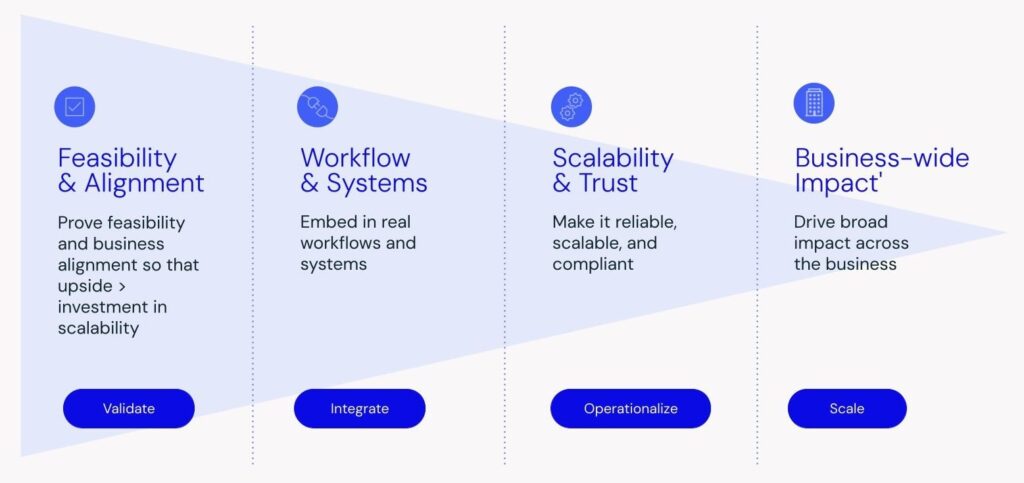
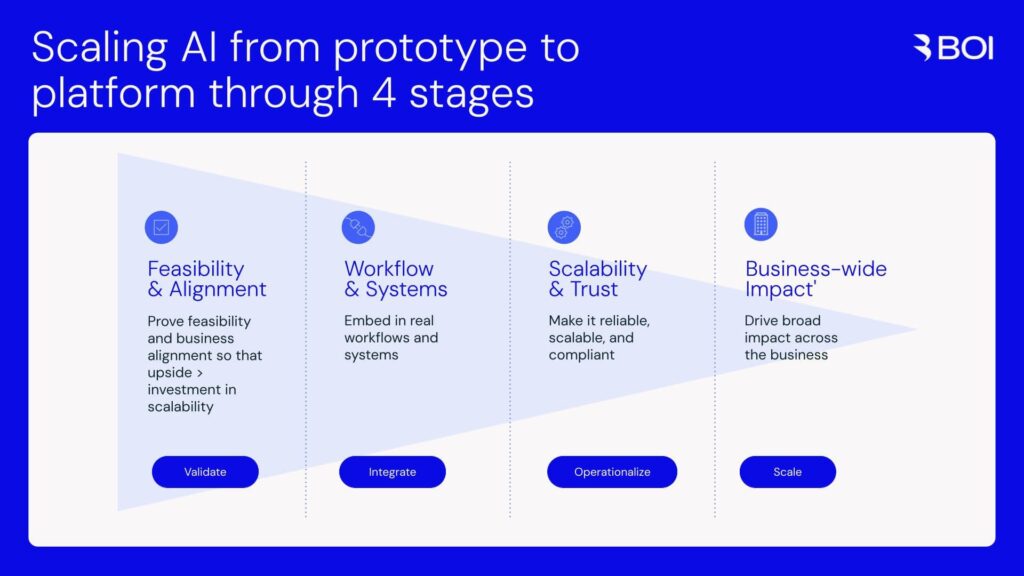
We break down the four key stages to take you from prototype to business-wide impact.
Dive deeper with our webinar on “Scaling AI from POC to business-critical products”
Stage 1: Validate
Stage 2: Integrate (Connect to real workflows and systems)
Stage 3: Operationalize (Make it reliable, scalable, and compliant)
Stage 4: Scale (Drive broad impact across the business)
But first, why scaling fails
Most organizations treat scaling like a technical follow-up to a successful POC: the model works, so now we deploy it to production.
But real-world scaling isn’t just about company-wide deployment. It’s about building trust, resilience to changing conditions, clear ownership, and adaptability. That requires solving challenges across infrastructure, workflows, governance, and culture.
Scaling requires dozens of interdependent decisions across architecture, infrastructure, engineering workflows, organizational design, governance, compliance, team capability, and more.
Stage 1: Validate (Feasibility and business alignment)
This first stage is often confused with technical prototyping. In reality, it’s broader. The goal isn’t just to prove that the model works, but to validate that scaling the solution would deliver enough business value to justify the investment of time and resources.
This means validating that:
- There is a real, high-priority business problem to solve
- The model can address the issue with confidence
- The potential benefits outweigh the cost of scaling
POCs should be designed not just to work, but to answer: “Will this scale?”
Too many teams burn resources scaling something that was never tightly aligned to business goals. A model can hit 90% accuracy, but if no one uses it or if the business impact is marginal, it’s a dead end.
Stage 2: Integrate (Connect to real workflows and systems)
Once you have validated that the AI initiative is solving a real problem and feasibility is established, the model must move out of the lab and into the real world.
These are the core integration challenges:
1. Real-world workflows (not sandbox demos)
Even the best model can’t generate business value without fitting into real-world workflows.
That could be a dashboard, a pricing tool, or an API powering personalization. But it must fit your systems and constraints. The first integration challenge is workflow fit:
- When does the model get triggered?
- Who is using it?
- How do they receive the output?
- What decisions or actions does the model influence?
- Does it need to be embedded in an internal tool, exposed via API, or surfaced in a UI?
These are the kinds of questions that often get ignored during the early POC phase. But in production, they define the actual user experience.
2. Cross-functional alignment
This is where many AI projects start to struggle.
“AI is not just a data science initiative. You need support from data engineering, software engineering, product, operations, and often legal and security.”
AI integration is a team sport. And the handoffs between teams, or lack thereof, can make or break progress. Sometimes the incentives just aren’t aligned across functions. Sometimes it’s not clear who’s accountable for what. Without cross-functional clarity and alignment, even the most promising model will stall.
3. Integration with core systems
Lastly, there’s the challenge of plugging AI into the systems that actually run the business. That’s often where real differentiation lies.
“Capabilities that generate real competitive advantage usually require models that access core systems, like a CRM for personalization, or an ERP to trigger supply chain actions.”
They may need to expose outputs through APIs or support real-time delivery. But this kind of technical integration (authentication, rate limiting, error handling, observability, permissions) is often more complex than building the model itself.
“Integration is not just about the models. It’s about making them useful, reliable, and connected to the business.”
This phase is where AI truly becomes part of a larger system. And if it’s not designed to plug into that system effectively, the pilot or POC won’t survive contact with reality.
If your model only works in isolation or relies on a bespoke data setup, it won’t survive contact with production reality
Stage 3: Operationalize (Make it reliable, scalable, and compliant)
Once an AI initiative is viable and ready to move toward production, the next big step is making the right foundational architecture choices. You want to make sure you are not building a monolith.
Building for modularity
From the start, your approach should be modular. Whether you’re building your own model, leveraging foundation models, or combining both, modular architecture gives you flexibility. And that’s everything in a fast-moving AI environment.
When systems are modular:
- Different teams can own different pieces
- You can iterate faster
- You can scale with less overhead
- You can swap components in and out as needs evolve
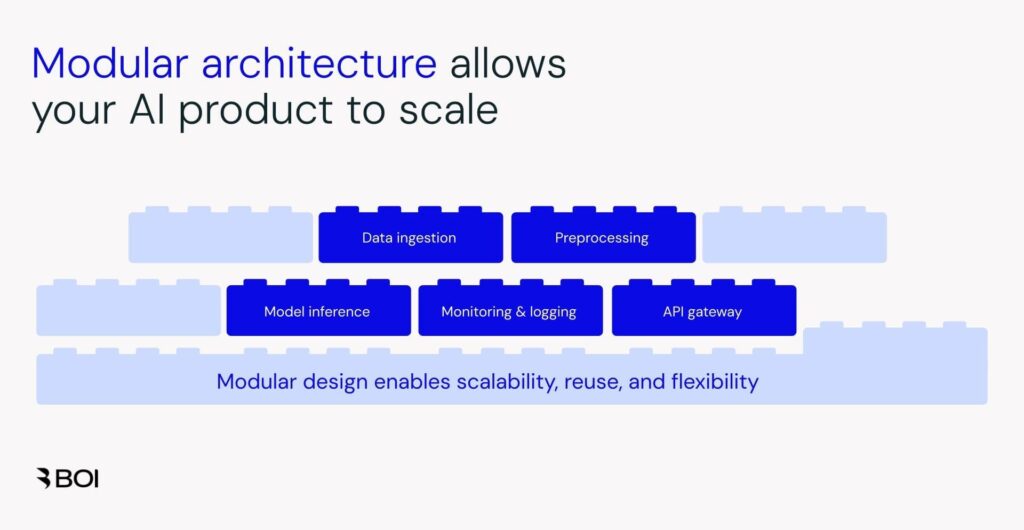
Modular principles
- Separate your data prep pipeline
- Isolate model inference
- Run monitoring and logging as standalone services
- Build CI/CD pipelines that support component-level deployments
For example, if you’re building an AI-powered insights tool, you don’t hardwire the foundation model directly into your app logic. Instead, you break it down:
- A retrieval module for RAG (retrieval-augmented generation)
- A prompt engineering module to define how inputs are structured
- A foundation gateway to switch between LLM providers or versions
- A post-processing module to format and validate outputs
- And a UI layer that’s always decoupled from backend logic
Why it matters for scaling
With a modular setup, if you need to upgrade your model, say switching from OpenAI to Claude or modifying your RAG retrieval logic, it’s just a one-module change, not a full-system rewrite.
“But if your logic, your UI, your model, your data sources are all entangled, then every change becomes a pretty stressful rewrite.”
As you scale to multiple use cases, this becomes even more critical. If every team builds their own stack from scratch, you’ll end up with redundant pipelines, inconsistent tooling and duplicated infrastructure.
Instead, you want to plug into shared modules, like a company-wide retrieval service or a centralized monitoring layer. That gives you speed, consistency, and a lot less risk.
Modularity isn’t just an architectural principle. It allows you to build AI systems that evolve, adapt, and scale – without collapsing under their own weight.
A practical playbook and 90-day roadmap to build an AI-first business that operates, learns, and grows with AI at its core.
Stage 4: Scale (Drive broad impact across the business)
As AI projects transition from proof-of-concept to production, it’s not enough for the model to be accurate or promising. It needs to be enterprise-ready: stable, secure, maintainable, and scalable. That means building robust infrastructure and practices around the model.
What enterprise ready AI looks like
Scale must be automatic
For real-time use cases like product recommendations or fraud detection, manual server scaling just isn’t viable. You can’t afford to hit usage caps or scramble to manage capacity. Scaling must be elastic, automatically growing and shrinking based on demand, without human intervention. Without elasticity, you either overpay for idle compute, or your system fails under pressure.
CI/CD for AI components
In modern software, CI/CD is a given. But AI systems need their own version of this. Updating model versions, prompt templates, retrieval logic. All of it must happen with minimal to no downtime. The key is making sure updates are safe, fast and repeatable.
AI systems
Data changes. Behavior changes. Regulations change. And when that happens, your model can start to drift. Enterprise AI systems need built-in drift detection and retraining pipelines. For example automatically trigger retraining when accuracy drops or use rollback mechanisms to revert if a new model performs poorly. This is especially critical for high-risk use cases; anything customer-facing, regulation-sensitive, or decision-critical.
AI solutions built for commercial impact
From multi-agent orchestration to simulation environments for decision-making, we design and build AI solutions through clear, actionable stages.
Your data infrastructure becomes a product
When AI moves from pilot to production, your data infrastructure becomes a product in itself.
Early-stage POCs often rely on offline datasets; CSVs, snapshots, or historical exports. That’s fine for proving a concept. But scaling across teams or systems means real-time, reliable, integrated pipelines.
Real-time vs. batch
The data processing model should fit the use case:
- For real-time decision-making (e.g. fraud detection): Use streaming architectures like Kafka for high throughput and low latency.
- For periodic tasks (e.g. quarterly forecasting): Batch processing with tools like Apache Spark is perfectly suitable.
But regardless of speed, data quality is non-negotiable.
Key data infrastructure practices
- Automated data validation: Catch nulls, anomalies, or schema mismatches before they hit the model.
- Lineage tracking: Understand where data came from, what changed, and how it influenced decisions – essential for trust, debugging, and audit.
- ELT over ETL: Shift to Extract-Load-Transform to preserve raw data, enhance auditability, and give teams more flexibility closer to the point of use.
AI at scale is an ops problem
AI systems aren’t experiments anymore, they’re products. And like any product, they require thoughtful operations.
“You need robust ops to make sure they’re stable, secure, maintainable, and resilient.”
Without the right foundation, elastic infrastructure, modular design, safe deployment, and solid data pipelines, even the best models won’t succeed at scale.
Organizational readiness
Successful scaling of AI depends as much on people, roles, and processes as it does on infrastructure. And in most companies, organizational readiness is the weakest link.
Even technically sound AI systems often struggle once they leave the lab. Why?
- No one owns the tool once it goes live
- Business users don’t trust or understand the outputs
- Teams don’t have the skills to operate or adapt the system
- Compliance, data privacy, or security reviews happen too late
- Solutions don’t fit into day-to-day workflows, so they get ignored
In other words, the model might work, but the system doesn’t.
Don’t scale later. Build for scale now.
Most teams think of “scaling” as a post-pilot activity. But the truth is, the decisions that determine scalability happen during the pilot: in how the problem is framed, how the system is built, and how success is defined.
You don’t need to over-engineer your first build. But you do need to build with scaling in mind:
- Solve a real business problem
- Align early with systems and workflows
- Create modular, observable pipelines
- Plan for retraining, ownership, and governance
- Design for reuse and extensibility
- Scaling is where AI earns its keep. But to get there, you have to start with the end in mind.
Looking to build an AI solution that delivers real business value at scale? Let’s talk.

Managing Director, Applied AI & Technology
Amir leads BOI’s global team of product strategists, designers, and engineers in designing and building AI technology that transforms roles, functions, and businesses. Amir loves to solve complex real world challenges that have an immediate impact, and is especially focused on KPI-led software that drives growth and innovation across the top and bottom line. He can often be found (objectively) evaluating and assessing new technologies that could benefit our clients and has launched products with Anthropic, Apple, Netflix, Palantir, Google, Twitch, Bank of America, and others.