The reasons why your POC isn’t scaling (and how to fix it)

Amir Ouki
Managing Director,
Applied AI & Technology
The AI hangover
Companies are waking up to what we call the AI hangover: the realization that proving something works isn’t the same as making it work at scale.
Most AI proof-of-concept’s fail to scale into tools that deliver real business impact, even though many of these initiatives showed promising results (such as a working model or automated gathering of specific insights). Some POCs never leave the lab, others collapse under the weight of technical debt, resistance, or unclear ownership.
Most companies aren’t short on AI ideas, they’re short on scaling discipline. The future belongs to those who scale intentionally.
In this post, we explore why so many organizations struggle to move from POC to enterprise impact. We’ll break down the biggest blockers of scaling (but not all of them), the technical and organizational shifts required to move fast without breaking things, and how to embed AI in a way that continues to scale.
Dive deeper with our webinar on “Scaling AI from POC to business-critical products”
Why exactly most AI POCs fail to scale
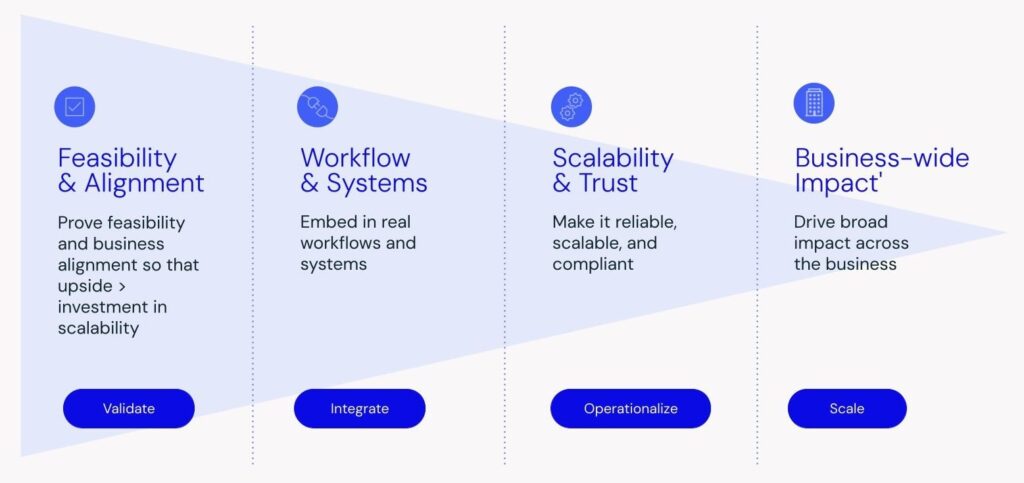
Today, competitive advantage is no longer only about AI experimentation but enterprise-wide AI integration. The real differentiator is how well AI scales across workflows, systems, and teams.
The hard truth is that showing a working model is no longer enough. If your POC wasn’t designed to integrate with your live systems, withstand real data “drift”, or align with actual business workflows, then scaling becomes virtually impossible.
1. Red flags in AI proof-of-concepts that can signal future failure
These are some of the red flags we see time and time again in AI POCs that can signal an upcoming failure of the project:
- No clear success criteria: If your team can’t define what “success” looks like beyond a working demo, you’ll struggle to justify next steps or secure long-term support.
- Misalignment with business strategy: POCs are often detached from the actual priorities of the business. They solve problems no one asked to solve.
- Tech-led without product thinking: Many pilots are led by technical teams with little product input. That leads to impressive algorithms that no one wants (or knows how) to use.
- No plan beyond the pilot phase: A POC without a roadmap is just an expensive experiment. Without a clear strategy of bringing it to production, it’s doomed to sit on a shelf.
When teams optimize only for technical feasibility, they miss the bigger picture: scaling AI requires solving for systems, ownership, and sustainability. It isn’t necessarily driven just by the model’s performance. The core question shouldn’t be “Can we build it?” but “Can we own, evolve, and operationalize this once it’s live?”
Until organizations make this shift in mindset from siloed lab experiments to long-term integration, they’ll continue to face diminishing returns from their AI investments.
Continue reading about the most common red flags to watch out for when building your AI solution
2. Key parts of a scalable AI solution
When it’s time to move from a single workflow to a production environment, things often crack: infrastructure, data pipelines, retraining logic, even basic monitoring.
This is what technical debt looks like when you scale AI too late. Especially if your AI pilot was optimized for showing that something could work, not to hold up when hundreds of users, live data streams, or compliance requirements get involved.
How do you make your solution scalable and enterprise-ready?
Modular design
If your AI pilot was built to solve a very specific problem, it most likely relies on specific data formats, hardcoded variables, and manual workarounds. This might get you a quick demo, but it won’t survive a handoff to other teams, or when the input changes once users start working with your tool.
Data infrastructure
Many AI pilots run on clean, curated datasets that are small enough to manage manually. At scale, things get messy, and data infrastructure becomes a product of its own. You will be dealing with challenges like unpredictable user input or the bandwidth demand of real-time data querying.
Model Ops
AI at scale is more than a one-time deployment; it requires very specific orchestration.
You don’t want your business-critical model to break because someone manually updated it on a Thursday and forgot to test edge cases.
Plan for performance drops
Once a model goes live, it will face conditions it was never trained on. Drift is inevitable at this stage. What matters is how fast and how safely you can respond, which depends on your solution’s drift-detection capabilities. Without real-time monitoring, alerting, and retraining triggers, teams often discover issues only after they’ve caused negative business impact.
3. Overlooking governance, trust and risks
Governance
Governance is what separates a promising AI experiment from a scalable, trustworthy product. And yet, it’s often one of the most overlooked aspects of AI development.
When AI lives in a lab, no one worries too much about security audits, GDPR compliance, or what happens when a model makes a bad prediction. But once your AI system reaches real customers and needs to make real decisions and actual revenue, the stakes change.

A technically brilliant model can still fail if people don’t trust it. That trust isn’t earned by accuracy scores alone, it has to be earned by transparency, accountability, and control. Without built-in explainability, bias monitoring, and access controls, your model might be right but unusable.
Privacy and compliance are still your responsibility
Scaling AI means ensuring the solution is ready for all regulatory scrutiny, such as GDPR, HIPAA, or other regional standards. Every scaled AI system is also a new attack surface. If your model is exposed via an API, accepts user inputs, or interacts with sensitive data, it needs to be protected. At scale, your processes should include strict safeguards against common attacks and security weaknesses

4. Project thinking (rather than platform thinking)
When every AI solution is built from scratch, scaling is painful and slow. Teams duplicate work. Models are hard to govern. Talent doesn’t transfer easily between projects.
But with a platform approach, time-to-deploy decreases, governance is standardized, and access control is consistent across tools. Cross-team collaboration improves: data scientists, engineers, and business owners share a common foundation. And impact compounds. Improvements to shared services start benefitting every use case that relies on them, not just one team that operates in a siloed environment.
Moving to a platform model isn’t just about software architecture, it’s an organizational shift. It means prioritizing enablement over ownership, and giving teams the tools and standards to build responsibly and independently, rather than gatekeeping AI through a central team.
5. Organization readiness is lacking
Even the best-designed AI systems won’t scale if the organization isn’t ready for them. We’ve seen highly performant models stall not because the tech didn’t work, but because the business wasn’t structured or skilled to adopt, operate, or trust the solution.
That’s why scaling AI is just as much a cultural transformation as it is a technical one.
New capabilities require new roles
AI at scale doesn’t run on autopilot. It requires a supporting cast of specialized roles to maintain, govern, and improve systems over time. These include:
- AI product owners embedded in business units to define real-world use cases and outcomes
- Model ops engineers responsible for deployment, monitoring, and retraining pipelines
- Prompt engineers fine-tuning generative models and crafting input/output logic
- Data stewards ensuring data quality, lineage, and policy compliance
If these roles don’t exist (or if responsibilities are unclear), AI solutions become orphaned after deployment. No one owns them → no one updates them → no one trusts them.
Cross-functional alignment isn’t optional
AI lives at the intersection of strategy, product, engineering, and compliance. That makes collaboration across teams essential. The most scalable AI solutions aren’t built in silos. They emerge from teams where:
- Business leads define the outcome and success criteria
- Engineers build modular, maintainable systems
- Legal and compliance teams shape governance from day one
- End users are involved early to shape and stress-test the solution
When alignment is missing, you get AI tools no one wants, no one understands, or no one can safely use.
Adoption fails when the cultural fit is wrong
The most common adoption failures aren’t technical but behavioral:
- The tool doesn’t fit into existing workflows
- Teams don’t understand how it was built or how to use it
- There’s no clear business case to support continued investment
To overcome these, you need more than onboarding. You need organizational fluency: shared language, clear expectations, and a culture that sees AI as a tool to be used and improved, not feared or misunderstood.
Scaling is the hard part. But it’s where the value is.
Anyone can spin up a proof of concept. Most organizations have dozens of them sitting in slides, labs, or GitHub repos. What separates the leaders today isn’t the number of pilots they’ve run but the number of systems they’ve successfully scaled.
POCs might demonstrate potential, but enterprise-grade AI generates measurable, compounding impact:
- It boosts decision-making speed and accuracy across departments
- It unlocks new revenue by enabling capabilities that were previously impossible
- It drives efficiency at scale, freeing up resources for higher-value work
- It builds infrastructure that others can reuse to solve new problems faster
Scaling requires you to solve for the whole system
Let’s recap what it really takes to scale:
- Architect for modularity: build flexible components that can evolve and interconnect
- Invest in infrastructure: enable versioning, monitoring, retraining, and rollback
- Embed governance early: ensure trust, transparency, and compliance by design
- Shift to platform thinking: reuse models, tooling, and data pipelines across use cases
- Build organizational fluency: equip teams to understand, use, and maintain AI responsibly
- Design for ownership: define who owns what after go-live, and how it’s improved over time
Scaling AI isn’t a finish line to reach at the end of the development stage. It’s a capability. And like any core capability, it only delivers when it’s structured, supported, and intentionally embedded into how the business operates, supported by a clear AI strategy.
Looking to build an AI solution that delivers real business value at scale? Let’s talk.

Managing Director, Applied AI & Technology
Amir leads BOI’s global team of product strategists, designers, and engineers in designing and building AI technology that transforms roles, functions, and businesses. Amir loves to solve complex real world challenges that have an immediate impact, and is especially focused on KPI-led software that drives growth and innovation across the top and bottom line. He can often be found (objectively) evaluating and assessing new technologies that could benefit our clients and has launched products with Anthropic, Apple, Netflix, Palantir, Google, Twitch, Bank of America, and others.