Scroll
Why AI transformation stalls
Training and adoption campaigns won't rewire your organization. Design will.
Since we published our AI-first Playbook, one question keeps coming back. Where is the change management chapter?
Communication plans and training assume people need convincing. Behavioral science points somewhere else: behavior follows the environment.
Organizations, like brains, get hard-wired. Faced with AI, they optimize old routines instead of redesigning them.
The fix is redesigning the organization so AI-first behavior becomes the default.
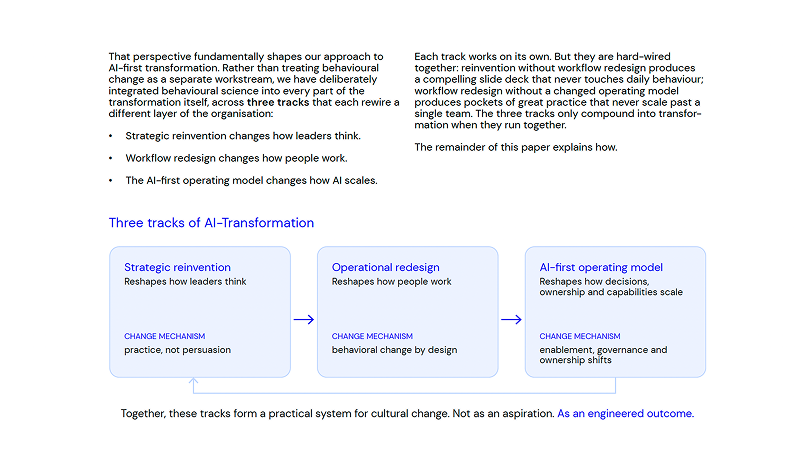
Three tracks
One transformation. Three change mechanisms.
01
Strategic reinvention
Changes how leaders think. Practice, not persuasion.
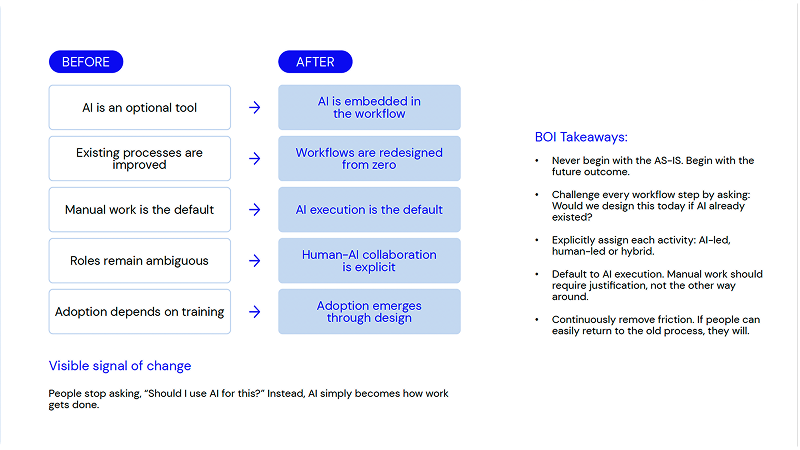
The shift
Success is measured by pilots
Success is measured by strategic choices
02
Workflow redesign
Changes how people work. Behavior by design.
The shift
Manual work is the default
AI execution is the default
03
AI-first operating model
Changes how AI scales. Ownership, enablement and governance.
The shift
Central teams build everything
Central teams enable and orchestrate
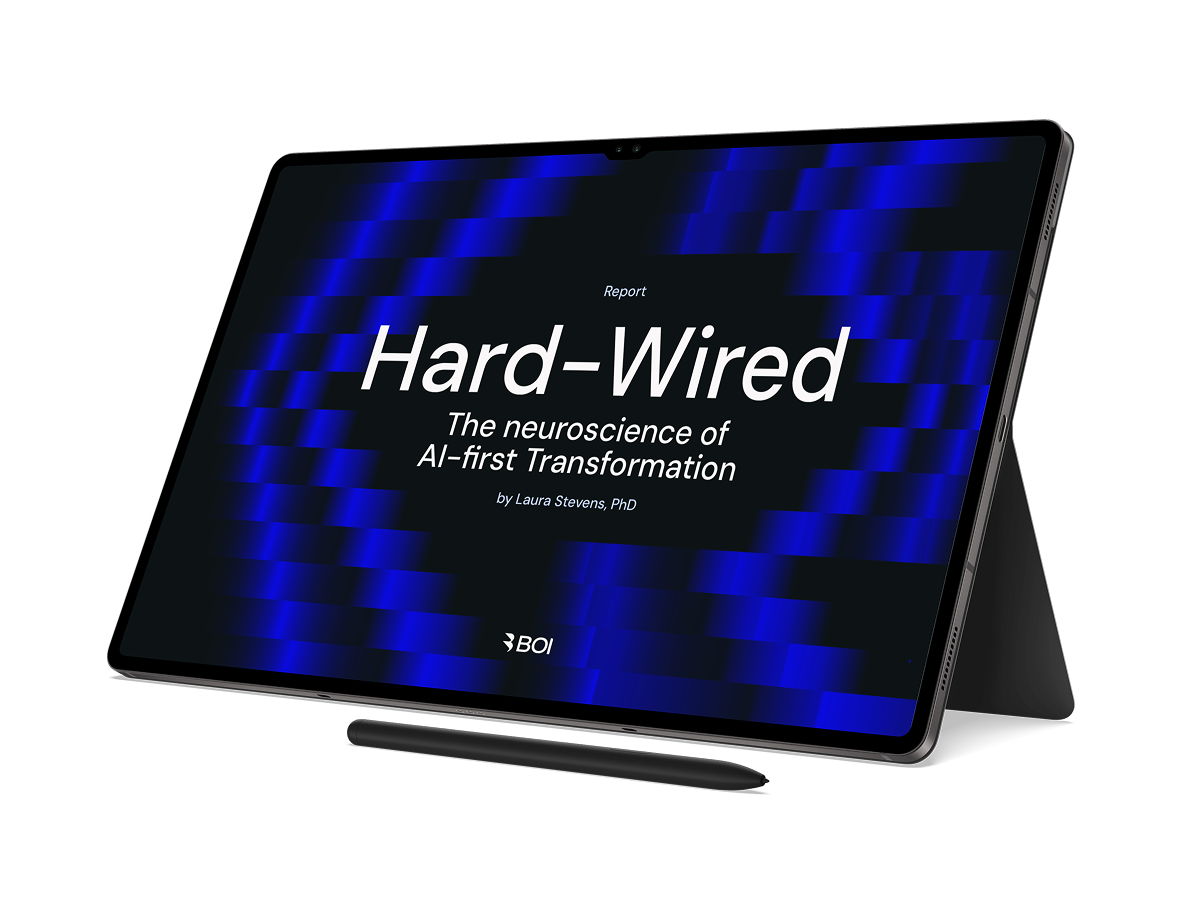
What you'll gain
40 pages to make AI-first the default.
- The three-track model
- The behavioral science behind each track
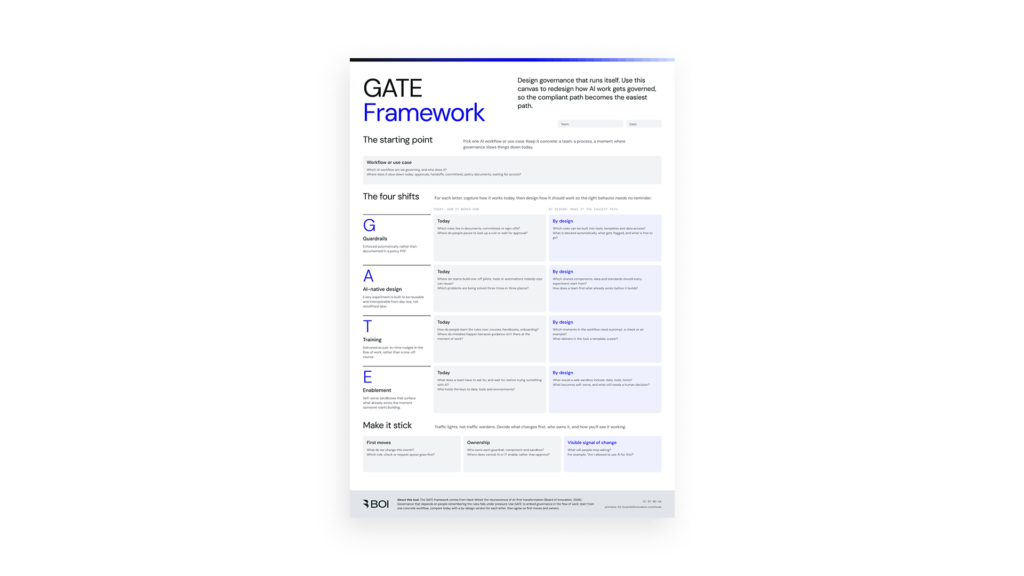
- The GATE framework for governance
- Before and after shifts per track
- Three real-world case studies
The GATE framework
Traffic lights, not traffic wardens.
G
Guardrails
Enforced automatically, not documented in a policy PDF.
A
AI-native design
Every experiment reusable and interoperable from day one.
T
Training
Just-in-time nudges in the flow of work.
E
Enablement
Self-serve sandboxes that surface what already exists.
Inside the report
Get a taste of Hard-Wired.
“A strategy isn’t really a strategy if it’s almost impossible to disagree with it.”
Laura Stevens, PhD
“We’re using governance built for the industrial era to manage technology evolving faster than any innovation in memory.”
Laura Stevens, PhD
“If you start with today’s workflow, you’ll almost always end with tomorrow looking remarkably similar to yesterday.”
Laura Stevens, PhD
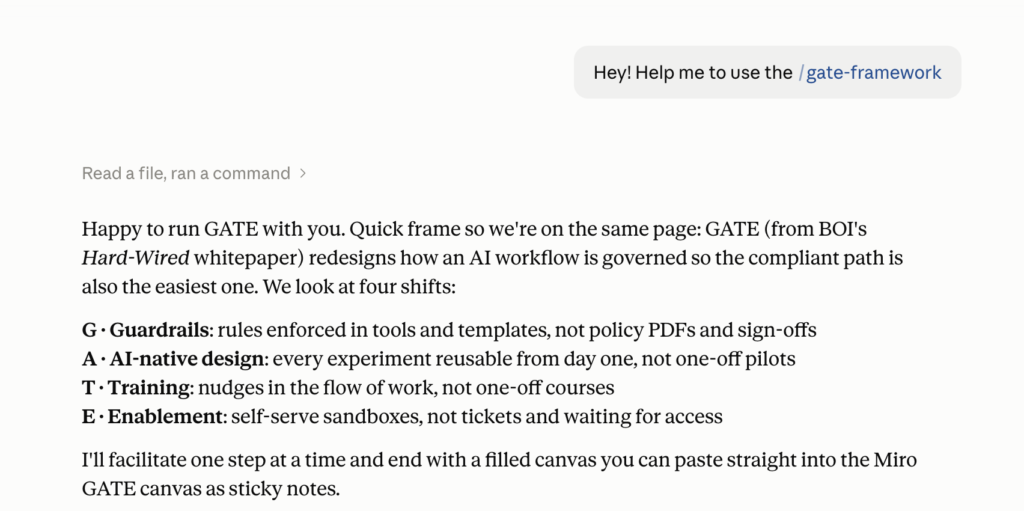
Run GATE with Claude
Don’t have a facilitator free this week? Let Claude run the session. The GATE Skill turns Claude into a GATE facilitator: it asks about your workflow, walks you through each letter, pushes back when an idea still relies on someone remembering, and hands you a completed canvas you can paste into Miro.
What the skill does
- Guides the session. Takes you through the same five steps as the workshop, one question at a time.
- Challenges the answers. Flags “by design” ideas that still depend on training or goodwill, and suggests defaults instead.
- Outputs the canvas. Returns the filled-in GATE canvas, first moves with owners, and the signal of change, ready for Miro or FigJam.
- Works solo or with a team. Prep alone before a workshop, or share your screen and fill it in live.
How to set it up (2 minutes)
- Download the tool. Inside you’ll find
gate-framework.zip. Keep it zipped, Claude uploads the .zip as is. - In Claude, open Settings, go to the Skills section and upload
gate-framework.zip. Skills are available on paid Claude plans. - Start a new chat and type: “Run a GATE session on our [workflow].”
Prompts to try
- “Run a GATE session on how our sales team writes proposals.”
- “Prep me for a GATE workshop with legal and IT next Tuesday.”
- “Here’s our current approval process for AI use cases. Where would GATE change the defaults?”
Free playbook
Download the playbook.
40 pages. Three tracks. Claude Skill. The behavioral science that makes AI-first behavior stick.

Written by
Partner, Board of Innovation
Laura brings a blend of strategic vision, analytical expertise and leadership, with a background spanning psychology, business consulting and organizational transformation. She has led large-scale data and AI transformations and is passionate about leading organizations through them.
Questions about Hard-Wired
What is Hard-Wired?
Hard-Wired is a 40-page playbook by Board of Innovation on the neuroscience of AI-first transformation. It explains why AI transformations stall and how to design an organization where AI-first behavior becomes the default.
Why do AI transformations fail?
Rarely because of the technology, and rarely because people resist change. They stall because organizations keep reproducing the conditions that make old behavior the easiest behavior: legacy workflows, delegated ownership and request-based governance.
What are the three tracks of AI-first transformation?
Strategic reinvention changes how leaders think. Workflow redesign changes how people work. The AI-first operating model changes how AI scales. Each track works on its own, but they only compound into transformation when they run together.
What is behavioral engineering in AI transformation?
Behavioral engineering means deliberately designing an organization so AI-first behavior becomes the natural default. It applies behavioral science, such as cognitive entrenchment, anchoring, the default effect, present bias and self-efficacy, instead of relying on training or persuasion.
What is the GATE framework?
GATE stands for Guardrails enforced automatically, AI-native design that makes every experiment reusable, Training delivered as just-in-time nudges in the flow of work, and Enablement through self-serve sandboxes. It embeds governance in the workflow, so the compliant path is the easiest path.
How is this different from traditional change management?
Traditional change management relies on communication plans, training and adoption campaigns. Hard-Wired treats behavioral change as part of the transformation design itself, not as a separate workstream.
What is an AI-native attacker exercise?
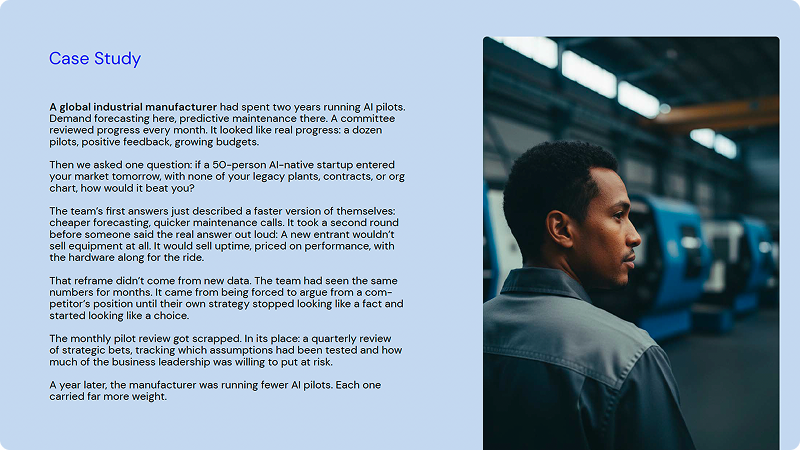
It is a leadership exercise that asks one question: how would a 50-person AI-native competitor beat you? It makes invisible assumptions visible. Board of Innovation runs it as a half-day session with executive teams.
Who wrote Hard-Wired?
Laura Stevens, PhD, Partner and Managing Director of Data & AI at Board of Innovation.
Keep learning
More resources on becoming AI-first


AI Leadership Bundle
