4 red flags to watch for when building & scaling your AI proof-of-concept

Amir Ouki
Managing Director,
Applied AI & Technology
Why do AI pilots not transition into scalable, enterprise-grade tools that deliver real business impact? Because the red flags of upcoming failure to scale are often built into the POC itself.
In this article, we break down the four most common reasons your POC isn’t going to scale. All are preventable if you catch them early.
Dive deeper with our webinar on “Scaling AI from POC to business-critical products”
Red flag 1: No clear success criteria
Many teams rush to innovate and prove their tech works, skipping over organization-wide alignment or understanding the business impact. POCs are framed as “experiments” with vague goals like exploring generative AI or testing out LLMs on our data sets, rather than specific, measurable outcomes. Many AI pilots haven’t moved out of their sandbox because they didn’t solve a real business problem.
Why it matters
Without having a clear definition of success, your team can’t prove value, and therefore make a case for further investment and wide-scale adoption. And you certainly can’t align stakeholders that don’t understand the big picture of what your solution actually solves. Once the demo is done, stakeholders don’t know what to compare it against or whether it warrants further investment. Executive sponsors hesitate. Next steps get deferred. The pilot quietly dies.
What to ask yourself
- Is the problem aligned with a strategic initiative? Will this lead to measurable revenue growth or increases in efficiency?
- If it doesn’t directly lead to revenue growth, how will success be measured? Qualitative feedback from users, early signs of trust, or ease of integration into workflows can all indicate success if measured correctly.
- Is there a clear roadmap post-pilot? A POC without a plan to bring it to production is just an expensive experiment.
Red flag 2: Misalignment with business priorities
Many POCs are built within innovation labs or by data science teams exploring the latest, most exciting technologies. While the technical challenge might be interesting, the business needs must supersede the want to implement a specific model or a tool. The result might be a technically advanced solution that solves a problem no one is urgently trying to solve.
Real value comes not from proving AI works but from embedding it into systems that matter.
Why it matters
Even a brilliant model won’t scale if the rest of the business doesn’t use it. If the problem isn’t high on anyone’s priority list, teams won’t reallocate budgets or workflows to adopt the solution. And if the expected outcomes don’t amount to P&L impact, it will be difficult to make a case for resources on integration or ongoing support.
What to ask yourself
- Will solving this problem remove real blockers and unlock new capabilities? Or are you building something that has great potential on paper but isn’t an actual challenge that requires further investment?
- Are business leaders actively involved, not just informed? Have they been able to experiment with the solution in its early stages and give their feedback?
- Is there a clear stakeholder who will own the outcome? Without executive understanding and support, wide adoption of the solution is bound to stall.
- Will success in this pilot unlock something bigger? AI solutions are unique in delivering compound impact when a flexible solution allows different teams to solve different problems without the need to manually tailor the entire system to their needs.
Red flag 3: Tech-led without product thinking
In many organizations, AI projects are still treated as technical experiments, owned end-to-end by data teams. Product management is brought in only after the model is working and needs scaling. But without a product mindset from the start, it’s easy to build something powerful that no one can or wants to use.
Why it matters
A good model doesn’t automatically make a good product. Without consideration of user workflows, context, and UX, the tool may generate accurate outputs, but still fail to drive action.
Many scaling challenges emerge from undefined ownership, unclear handoffs, and black-box behavior that users don’t trust. When product teams are excluded, feedback loops disappear and feature scoping becomes reactive, not proactive. That makes adoption fall flat. That makes adoption fall flat.
What to ask yourself
- Is there a defined way of user interaction for how this AI solution will be used? What triggers it, where does it show up for users to work with, what action is it meant to improve?
- Are design, UX, or product teams involved in shaping the experience?
- Can users actually understand outputs? Is it immediately clear why and how the model came to a conclusion, or is it a black-box that they have to blindly trust?
Red flag 4: No plan beyond the pilot phase
In the early stages, teams are focused on proving feasibility. To move fast, they often cut corners:
- manually cleaning data,
- hardcoding parameters,
- or deploying in isolated environments.
These hacks make for impressive demos but fragile foundations. Many pilots are engineered for curated success, not real-world complexity.
But even when a pilot delivers early promise, few teams already have a clear view of what happens next. There’s often no defined handoff between product, data, and engineering. Without planning for these realities up front, your promising POC stalls, both technically and organizationally.
Why it matters
AI isn’t plug-and-play. Moving from a working demo to a production-grade solution involves a long tail of decisions:
- Model monitoring
- Retraining strategy
- Infrastructure
- Compliance
- Data access
- User onboarding
If the demo was built with brittle shortcuts, these problems are magnified:
- Pipelines that can’t ingest messy, real-world data.
- Models that need rewriting to be updated or swapped.
- Outputs that don’t fit production APIs.
- Infrastructure that can’t autoscale or monitor itself.
What to ask yourself
- Is there a clear roadmap for MVP or production build?
- Are infrastructure, DevOps, and compliance teams involved already?
- Are data pipelines modular and version-controlled?
- Is retraining automated, and are performance metrics like drift and latency monitored in real time?
AI solutions built for commercial impact
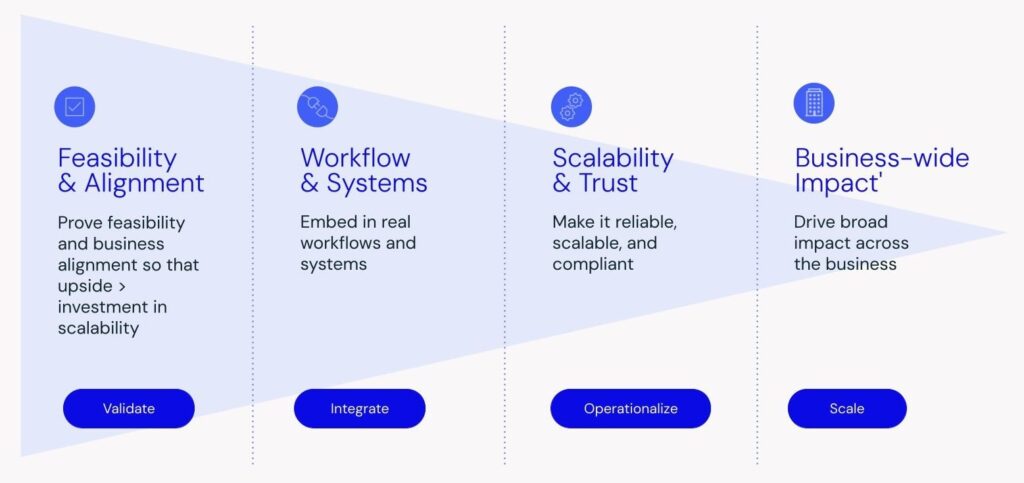
From multi-agent orchestration to simulation environments for decision-making, we design and build AI solutions through clear, actionable stages.
The sooner you address these issues, the easier it will be to scale later
Successful AI pilots align with strategy, define success clearly, anticipate ownership, and build for what comes next. Most importantly, they avoid the trap of treating AI as a one-off experiment. They treat it as a capability to be nurtured, embedded, and scaled across the business.
If you’re running a POC, ask yourself:
- Does this have a path to production?
- Are the right people involved, from engineering to end users?
- Are we solving a problem the business cares about now?
- Will the system we’re building today survive contact with the real world?
Looking to build an AI solution that delivers real business value at scale? Let’s talk.

Managing Director, Applied AI & Technology
Amir leads BOI’s global team of product strategists, designers, and engineers in designing and building AI technology that transforms roles, functions, and businesses. Amir loves to solve complex real world challenges that have an immediate impact, and is especially focused on KPI-led software that drives growth and innovation across the top and bottom line. He can often be found (objectively) evaluating and assessing new technologies that could benefit our clients and has launched products with Anthropic, Apple, Netflix, Palantir, Google, Twitch, Bank of America, and others.