The trap of the traditional AI roadmap (and the AI-first alternative)

Laura Stevens
Managing Director of Data & AI
AI is rapidly becoming the core infrastructure of modern business.
Yet most organizations are still planning for AI as if it were a layer on top of their existing operating model. The pattern is familiar: pilots multiply, teams experiment, governance expands, and investment grows. Meanwhile, the organization continues to operate in largely the same way. AI becomes something the business is doing, not something the business is becoming.
The traditional AI roadmap is built for incrementalism
Most AI roadmaps start with use cases. They are built around bottom-up discovery, local experiments, and quick wins across functions. Leaders ask teams to explore where AI can help, automate tasks, and improve efficiency.
The roadmap becomes a collection of initiatives:
- A customer support chatbot
- Automated reporting
- Copilot rollouts for knowledge workers
- AI-assisted marketing content
- Predictive dashboards for operations
These projects can create value. They can reduce time spent on repetitive work. They can improve output quality. They can generate momentum.
But they don’t add up to transformation.
They spread resources thin, reinforce fragmented ownership, and keep AI disconnected from the strategic core of the business. Many organizations end up with a large portfolio of AI activity, but no coherent direction and no compounding advantage.
This is where roadmaps quietly die.
Discover the alternative: Download the Playbook for Becoming AI-First
Welcome to pilot purgatory: active experimentation without meaningful transformation
Most organizations don’t fail because AI doesn’t work. They fail because they approach AI as an adoption challenge rather than an operating model redesign.
Pilots become the dominant unit of progress. Teams keep proving value in isolated pockets. New experiments are added faster than old ones can be scaled. Success becomes difficult to replicate because every pilot is built on a different tool, a different workflow, and a different team’s assumptions.
Eventually, the organization reaches a predictable state:
- Dozens of active experiments
- Limited reuse across teams
- Increasing tool sprawl and cost
- Fragmented data flows and unclear governance
- Growing fatigue and declining belief
The deeper opportunity of AI sits in a different layer of the business. It sits in how value is created, decisions are made, and work is organized.
Organizations that treat AI as a feature upgrade often end up with marginal gains and competitive parity. Organizations that treat AI as infrastructure start redesigning the business around intelligence.
‘’At BOI, we have made it our mission to shape clarity on the alternative. In a world where many organizations are overwhelmed by fragmented pilots, vague ambitions, and tooling hype, we’re committed to providing a clear, practical blueprint for leaders who want to move differently, with purpose, with speed, and with a long-term advantage in mind.’’
What matters now isn’t size, it’s structure
AI-first companies (those structured around AI as a native capability) are reshaping markets. They are scaling with small teams, automating entire workflows, and delivering experiences that traditional organizations struggle to match.
Agility explains how AI-first companies move faster; but speed alone isn’t enough. To secure lasting advantage, these firms build a new kind of moat. The old moats, e.g. scale, brand spending, capital access, are rapidly eroding. In the AI era, they no longer guarantee defensibility. Open-source models, cloud-based infrastructure, and off-the-shelf agents have leveled the technical playing field. What matters now isn’t size, it’s structure.
AI-first companies create moats differently. Their advantage is built into the architecture of how they learn, improve, and scale:
- Proprietary data loops that continuously refine model performance through user feedback, behavior signals, and task-specific data, making the product or service harder to replicate with every interaction.
- Embedded, reusable workflows and agents tailored to domain-specific contexts, allowing for hyper-relevant automation, faster decision-making, and differentiated customer experiences that evolve in real time.
- Strategic distribution and “default” status, where products are embedded in everyday workflows, APIs, and platforms, driving sticky adoption and reducing churn without costly acquisition.
- Talent leverage through AI-augmented teams, where small, high-performing squads armed with agents and copilots routinely outperform bloated teams still relying on manual effort.
Together, these ingredients don’t just add efficiency, they create non-linear, asymmetrical advantage. AI-first orgs don’t compete on the same terms. They learn faster, adapt continuously, and grow with compounding returns.
Example: In e-commerce, AI-first companies use real-time agents to optimize pricing, tailor content, and route fulfillment dynamically – based on user signals, inventory, and behavior. Their advantage isn’t margin, it’s learning velocity. Traditional firms can’t match that speed without rewiring their architecture.
A practical playbook and 90-day roadmap to build an AI-first business that operates, learns, and grows with AI at its core.
The alternative: What an AI-first roadmap looks like
Becoming an AI-first company requires a deep, structural shift, not just in technology adoption, but in how the business operates, decides and grows.
Rather than layering AI onto legacy systems, AI-first companies rethink how value is created, how work gets done, and how the organization scales. They embed AI at the center of strategy, workflows, and execution.
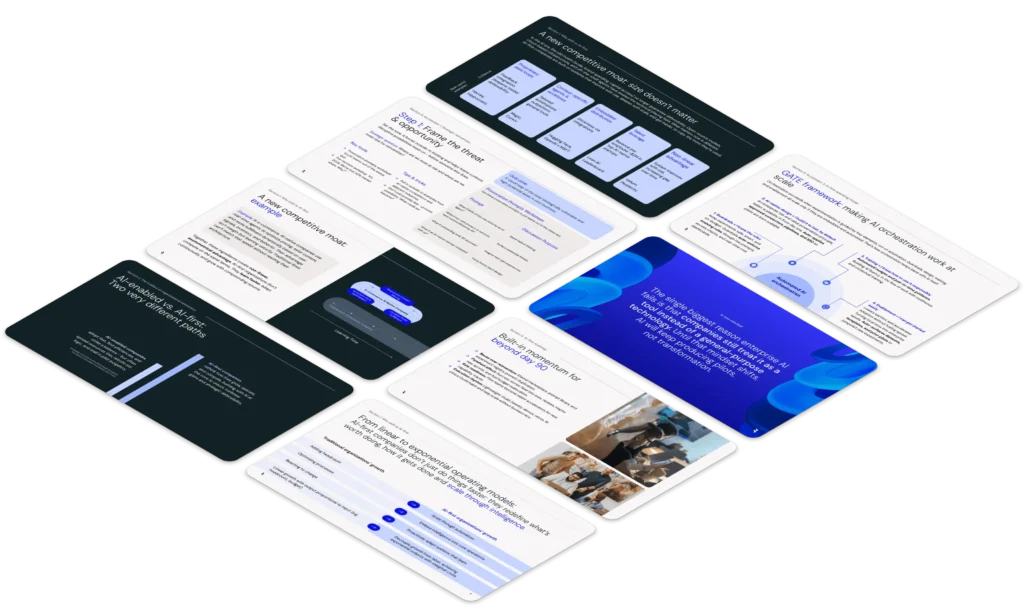
The Playbook for Becoming AI-First introduces a system that is structurally designed to learn faster, adapt continuously, and scale with intelligence at its core. It introduces a system for transformation built around three interconnected tracks:
- Strategic reinvention: Reframe how your company creates and defends value in an AI-first world
- Operational redesign: Rebuild the workflows, roles, and tools that power everyday execution
- AI-first operating model: Establish the systems, governance, and capabilities that make AI scale sustainably
If you want AI to change outcomes, the roadmap has to start with structural choices: where you’re making bets, which workflows you’re rebuilding from zero, and what operating model makes success repeatable.
That’s what our AI-first playbook is built for: a practical system to move from scattered pilots to focused bets, redesigned execution, and a model that scales.
Keen to explore how you become AI-first? Drop us a note

Managing Director of Data & AI
Laura Stevens, PhD, is the Managing Director of Data & AI, bringing a unique blend of strategic vision, analytical expertise, and leadership acumen. With a background in neuropsychology, business consulting and organizational transformation, she has successfully navigated a career spanning academia, consulting, and industry leadership. As a former VP Data & AI in an international organization, Laura has led large-scale Data & AI teams covering data science, machine learning, data engineering, data governance, and visualization. She is passionate about leading organizations through their data & AI transformation.