AI-first vs. AI-enabled: what's the difference (and who will win)

Laura Stevens
Managing Director of Data & AI
Most organizations today are becoming AI-enabled.
They’ve launched pilots, rolled out copilots, automated a few workflows, and added AI to the leadership agenda. Activity is high. Tooling is expanding. In many cases, adoption is real.
And yet, impact often remains incremental.
This is the distinction that matters most right now: the gap between being AI-enabled and becoming AI-first. These are not two steps on the same maturity curve. They represent two fundamentally different operating logics.
AI-enabled organizations treat AI as an add-on.
AI-first organizations treat AI as an operating system.
That difference changes everything.
Dive deeper into the full system for becoming AI-first with this playbook.
Why the traditional AI playbook fails
The standard industry playbook for AI is familiar: adopt fast, find efficiencies, strike a balance. Use AI to accelerate tasks, improve processes, and support decision-making.
The intent is pragmatic; unlock productivity, modernize operations, keep pace.
But the underlying assumption remains unchanged: the organization stays structurally the same. Workflows remain intact. Decision rights stay where they are. Strategy is still built around human-driven cycles, with AI bolted on for support.
The result is predictable. Companies accumulate pilots and point solutions. Investment spreads thin across dozens of experiments. AI delivers local wins, but value doesn’t compound.
Many organizations end up “busy with AI,” but unable to articulate how it fundamentally changes the business.
This is why the distinction between being AI-enabled and becoming AI-first matters. New technology does not create value. New operating logic does.
AI is becoming the core infrastructure of business
AI has matured at unprecedented speed. Foundation models, autonomous agents, and low-code tools have dramatically lowered the barriers to entry and scale.
Today, small teams can build global businesses, automate entire workflows, and deliver services that outpace traditional players.
This new wave of AI-first companies proves a simple point: you don’t need massive headcount or capital to scale. You need AI at the core.
According to the Lean AI Native Companies Leaderboard, the most successful early-stage AI-native startups operate with teams under 50 people and generate more than $2.5M in revenue per employee.
This shift isn’t incremental. It’s structural.
What is an AI-enabled organization?
An AI-enabled organization adopts AI to improve existing processes and drive efficiencies, layering new tools onto legacy workflows without fundamentally changing how the business operates or competes.
AI is deployed into existing structures. Teams identify use cases across functions. Tools are introduced to accelerate tasks, assist decisions, and improve workflows.
AI is treated as a capability to deploy; valuable, but not foundational.
AI-enabled is a rational first step. But it is not transformation.
What is an AI-first organization?
An AI-first organization is structured around AI as a native capability, making it the foundation of how the business creates value, operates, and competes.
This is not a tooling upgrade. It is a structural reinvention.
Scale through intelligence
Traditional organizations grow by adding headcount, optimising processes, and reacting to change.
AI-first organizations flip this logic. They scale through automation, embed intelligence into operations, and adapt through systems that learn.
Redefinewhat’s worth doing
AI-first companies don’t just do things faster. They redefine what’s worth doing and how it gets done; Intelligence is embedded directly into the flow of work. Execution shifts from human-led processes to AI-orchestrated systems. Decision-making becomes real-time, predictive, and continuously learning. Workflows are rebuilt with AI as a native actor, not retrofitted as an assistant.
This is what allows small teams to outperform large organizations. Advantage no longer comes from headcount, hierarchy, or scale. It comes from reusable workflows, proprietary learning loops, embedded distribution, and decision velocity.
Have agility as a structural advantage
Scaling through intelligence is only part of the story. AI-first organizations don’t just grow differently – they adapt differently.
Their structures are designed for responsiveness. Workflows and decisions can be reconfigured in real time by modifying agent logic, not retraining humans.
For example: If regulations change, an AI-first insurer can update policy logic in hours through model instructions. A traditional insurer requires retraining, compliance reviews, and months of rollout.
AI-first companies operate through modular, orchestrated systems, not rigid hierarchies.
Intelligence fuels growth. Agility ensures survival.
A practical playbook and 90-day roadmap to build an AI-first business that operates, learns, and grows with AI at its core.
Size doesn’t matter - structure does
The old moats, scale, brand spending, capital access, are eroding fast. Open-source models, cloud infrastructure, and off-the-shelf agents have levelled the technical playing field.
In the AI era, size doesn’t guarantee defensibility. Systems do.
AI-first companies build moats differently:
- Proprietary data loops that improve with every interaction
- Embedded workflows and agents tailored to domain-specific contexts
- Distribution through “default” status inside everyday work
- Talent leverage through AI-augmented teams that outperform bloated organizations
These aren’t efficiency gains. They’re compounding advantages.
The moat is no longer a static asset. It’s a system that improves with use.
The real difference is operating logic, not adoption speed
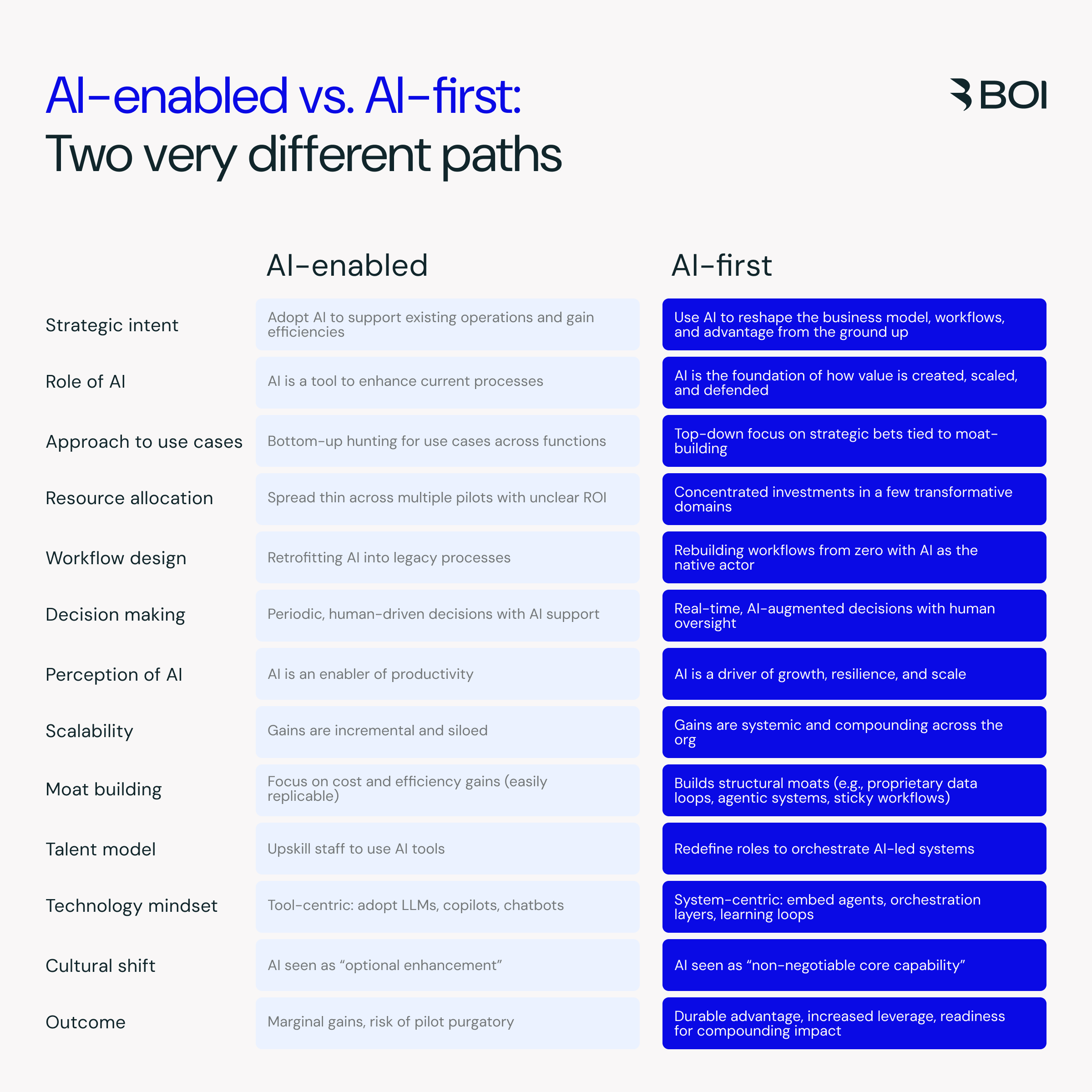
The difference between AI-enabled and AI-first isn’t how many tools you deploy. It’s whether AI changes the operating logic of the organization.
AI-enabled
Adopt AI to support existing operations and gain efficiencies
Bottom-up use case hunting
Spreads resources across pilots
Retrofits AI into legacy workflows
Siloed gains
AI-first
Use AI to reshape the business model, workflows, and advantage from the ground up
Top-down strategic bets tied to moat-building
Concentrates investment into a few transformative domains
Rebuilds workflows from zero
Systemic, compounding advantage
This is not about doing more AI. It is about operating differently because of AI.
Becoming AI-first requires reinvention, not implementation
It requires deliberate redesign across three interconnected layers:
- Strategic reinvention reshapes how leaders think about advantage in an AI-native world.
- Operational redesign reshapes how work flows day to day, making AI-led execution the default rather than the exception.
- An AI-first operating model reshapes governance, ownership, and capability building so autonomy can scale without fragmentation.
Together, these shifts turn isolated experiments into a coherent system. They move AI from adoption to enterprise operating logic.
The shift is unavoidable
Eventually, every organization will be forced out of the “AI as a tool” mindset.
The only question is whether the shift happens intentionally, or whether the market forces it through disruption.
AI-enabled buys time. AI-first builds structural advantage.
The companies that will dominate the next decade won’t just adopt AI. They will be built around it.
Keen to explore how you become AI-first? Drop us a note

Managing Director of Data & AI
Laura Stevens, PhD, is the Managing Director of Data & AI, bringing a unique blend of strategic vision, analytical expertise, and leadership acumen. With a background in neuropsychology, business consulting and organizational transformation, she has successfully navigated a career spanning academia, consulting, and industry leadership. As a former VP Data & AI in an international organization, Laura has led large-scale Data & AI teams covering data science, machine learning, data engineering, data governance, and visualization. She is passionate about leading organizations through their data & AI transformation.