AI is shifting power, margins and control: How exposed is your business model to AI?

Laura Stevens
Managing Director of Data & AI
After an initial rush to deploy AI internally, more companies are realising this was only part of the story. AI is no longer just changing how work gets done inside the company, it is reshaping how customers behave, where they engage, and what they now consider “table stakes,” putting real pressure on long-standing business models.
As with most forms of disruption, this shift doesn’t arrive as a single dramatic moment. It creeps in gradually: through eroding differentiation, margin pressure, changing customer interfaces, or smaller, faster competitors outperforming incumbents with a fraction of the resources. When this pressure starts to surface, the first response inside many organizations is reassurance.
“Our customers still want humans.”
“Regulation will protect us.”
“AI isn’t good enough yet.”
Each of these statements may be true and still largely irrelevant. AI-driven disruption doesn’t require every condition to align at once. It only needs enough pressure along the right dimensions to tip the balance.
Often, differentiation erodes long before replacement.
Interfaces shift before products disappear. Margins collapse while demand remains.
AI disruption is rarely a single moment or technology. It is the cumulative effect of pressure across work, economics, trust, interfaces and competition and by the time it feels undeniable, the strategic room to respond has already narrowed.
AI disruption isn’t one thing, it’s the accumulation of pressure across work, economics, trust, interfaces and competition.
While many leaders can feel that something is shifting, we’ve noticed that they struggle to articulate where their business is most exposed and why.
Dive deeper in the webinar How AI is disrupting your business model – and how you should respond, where we break down the concrete ways AI is reshaping value pools across industries and share the transformation moves leaders must make.
The four ways AI actually disrupts businesses
AI disruption can be seen as any structural loss of value, power, control or position caused by AI, whether through replacement, commoditization, displacement by AI-native competitors or re-intermediation at the interface. That definition matters, because AI doesn’t just replace work, it reshapes where value sits.
Across industries, we consistently see four distinct disruption patterns emerge.
1. Direct replacement of human execution
This form of disruption primarily hits execution-driven service businesses, where customers are paying for human time to produce a defined output. Think translators, copywriters, content studios, basic research providers or analytical services built around repeatable formats.
In these models, AI doesn’t replace the service customers want. It replaces the human execution of the work itself. The output still exists, i.e. a translation, a text, an analysis, but human labor is no longer the default way it gets produced.
This happens when:
- the work follows structured or repeatable patterns,
- AI reaches production-grade quality for a “good enough” outcome,
- customers accept automated execution as the baseline,
- and regulation does not explicitly require a human in the loop.
The disruption is fundamentally operational and economic. Once AI becomes the default executor, the assumptions that underpin the business collapse:
- staffing models built on billable hours no longer make sense,
- pricing based on human effort becomes misaligned with value,
- capacity scales with compute, not people.
Humans may still play a role, i.e. in review, exception handling or accountability, but they are no longer where the value is primarily created. That shift is what makes this form of disruption so destabilizing.
Typical examples include businesses active in (human-led) translation or copy-writing. It is the most visible form of AI disruption.
Example: AI ate the bottom of the consulting pyramid
Take the example of a mid-sized market insights consulting firm, shared by Luk Smeyers. A meaningful share of its revenue came from small, ad-hoc projects: quick surveys, basic segmentations, competitor scans and rapid insight decks ahead of board meetings or strategy off-sites. These projects relied heavily on junior teams to design questionnaires, clean data, code responses and assemble slides under senior supervision.
As clients started using AI tools embedded in survey platforms and internal data environments, they began generating first-pass insights themselves. Demand didn’t disappear, but human execution of the first draft did. Volumes dropped, junior capacity was reduced, staffing pyramids no longer worked and AI effectively became the default executor of this work.
In practice, this first form of disruption almost always triggers the second: Commoditization and margin erosion.
2. Commoditization and margin erosion
In this form of disruption, AI collapses differentiation and pricing power of the service. It doesn’t eliminate the need for the service. Instead, it steadily erodes the ability to charge a premium. What used to justify higher prices, i.e. expertise, effort and perceived differentiation becomes harder to defend once AI changes how value is created and perceived.
This erosion typically happens through two reinforcing mechanisms:
- Standardization of output: AI dramatically reduces variation in quality. Tasks that once depended on individual skill, experience or judgment start producing consistent “good enough” results at scale. As a result, outputs across providers begin to look similar, quality becomes harder to signal or explain, and customers anchor on lower reference prices The service still exists, but differentiation collapses. When quality converges, premiums disappear, even if the underlying work remains complex.
- Unbundling of the service: At the same time, AI quietly splits bundled services apart. AI takes over the most visible, scalable, and product-like parts of the offering: data processing, pattern detection, drafting, scoring or first-pass analysis. What remains with humans is still essential, i.e. context, interpretation, validation, explanation, accountability, but it becomes less tangible and harder to price on its own. This creates a subtle but powerful shift: customers perceive that “most of the work” is already done by the system, human involvement feels like an add-on rather than the core value, willingness to pay for the remaining human layer declines. Even when human judgment is still required, its economic weight in the bundle shrinks. AI doesn’t remove the service. It removes the part customers used to pay for.
In short, standardization weakens differentiation, while unbundling weakens value attribution. Together, they create a pricing squeeze:
- Prices come under pressure while expectations remain high
- Margins erode even as demand stays stable
- Providers are forced to deliver more value with less monetisable work
This is why commoditization often unfolds gradually. There is no single replacement moment, just steady pressure on margins until the business model no longer works as designed.
Example: Commiditizing output
One of our clients is a well-established assessment provider. For years, their differentiation was built on senior expertise, rigorous methodology and high-quality written reports. Clients trusted the assessments and were willing to pay a premium for them.
Over the past 18–24 months, that dynamic started to shift, quietly at first. Clients didn’t stop buying assessments. Volumes remained stable. But conversations increasingly focused on price, scope and turnaround time. Procurement teams began asking why assessment reports from different providers looked “largely comparable,” and whether lighter or cheaper versions were possible. What changed wasn’t the need for human judgment. It was the perception of uniqueness.
AI-enabled tools had started to standardise large parts of the assessment process across the market: competency frameworks, interview guides, scoring logic and even the structure and language of reports. As a result, what clients once experienced as deeply expert-driven now felt more like a repeatable diagnostic. “Good enough” became widely available.
The impact showed up economically. Margins came under pressure. Discounts became more common. Senior consultants were increasingly pulled into delivery work to defend quality and justify pricing, instead of focusing on higher-value advisory conversations.
In this case, AI did not replace assessors. It commoditised the assessment output. The strategic challenge for the firm was not whether assessments would disappear, but whether they could still command a premium unless they were repositioned, away from standalone reports and toward demonstrable decision quality, predictive impact, and outcomes over time.
3. Displacement by AI-native competitors
Disruption accelerates when AI-native players redesign both the value proposition and the operating model around AI. Enabled by foundational models and low-code/no-code tools, small teams can now build sophisticated offerings without large engineering organizations or heavy upfront investment. Capabilities that once took years to develop are accessible from day one. Their advantage lies in talent leverage. AI-native organizations deliver the output of large professional services teams with a fraction of the headcount, allowing them to operate cheaper, scale faster, and adapt continuously.
Because execution is encoded in software and agent logic, workflows and decisions can be reconfigured in near real time, without retraining people or reorganizing teams.
As a result:
- small teams outperform much larger organizations,
- services launch faster and price more aggressively,
- adaptation becomes continuous rather than episodic,
- and assumptions about scale, cost and complexity break down.
This is not about better tools, but about a structural asymmetry incumbents struggle to match.
4. Re-intermediation around new defaults
In this form of disruption, AI doesn’t replace the product or commoditise the output but takes over the interface through which decisions are made.
AI assistants, copilots and agents increasingly become the default layer people use to search, compare and decide. Instead of customers actively browsing options, evaluating brands or engaging with traditional sales channels, they delegate those choices to AI systems that optimise for convenience, fit or price. What gets disrupted is visibility and influence, not the underlying product or service.
This happens when:
- decisions can be safely delegated to an agent,
- switching costs between providers are low,
- customers value speed, synthesis, and “best option” over brand exploration.
As a result, businesses can remain relevant and high-quality, and still lose ground, because they no longer control how customers encounter them.
Examples
- In pharma, medical AI copilots increasingly shape treatment options before doctors ever engage with reps, weakening traditional influence models.
- In consumer services (telecom, insurance, utilities), AI-driven comparison tools surface “best value” options instantly, compressing prices and reducing brand differentiation.
- In B2B services, AI procurement agents shortlist vendors based on structured criteria, sidelining relationship-based selling.
In an agent-driven world, being the default choice inside the interface matters more than being the best product on paper.
If you don’t shape how AI discovers, evaluates and selects you, your business risks becoming invisible, even while demand still exists.
Assessing your business model's risk for AI disruption
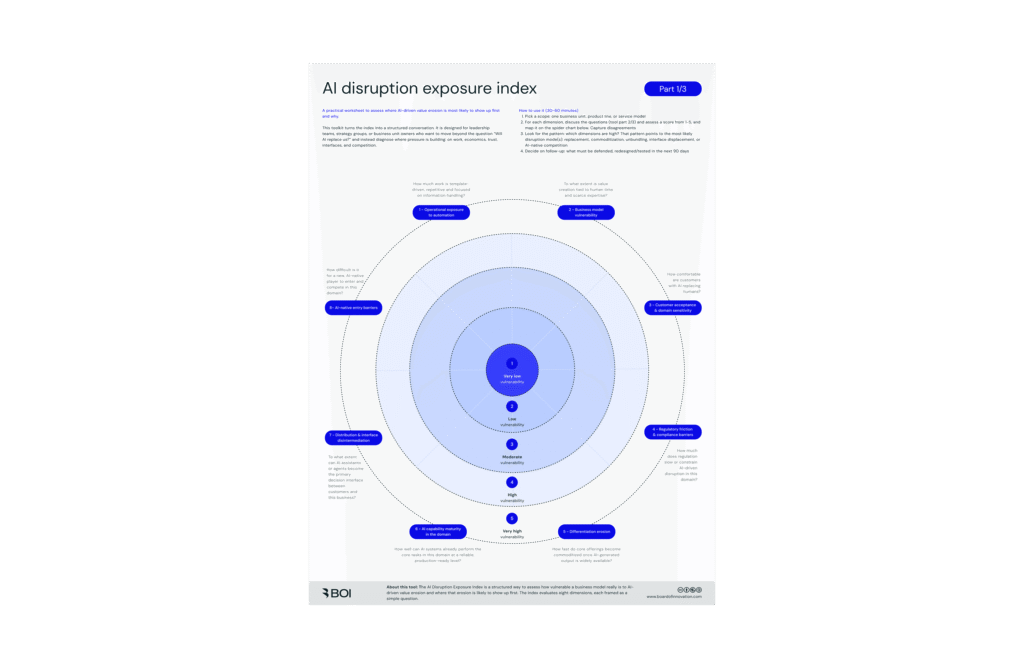
To help leaders assess the degree to which their business model is at risk for AI disruption, we have launched the AI Disruption Exposure Index: a structured way to assess how vulnerable a business model really is to AI-driven value erosion and where that erosion is likely to show up first.
The index evaluates eight dimensions, each framed as a simple question:
- Operational exposure to automation: Can the work be automated?
- Business model vulnerability: Would the business model break if it is?
- Customer acceptance & domain sensitivity: Would customers accept AI-native alternatives?
- Regulatory friction & compliance barriers: Would regulation allow it?
- AI capability maturity in the domain: Is AI actually good enough at the core task?
- Differentiation erosion: Do we still stand out once AI becomes widespread?
- Distribution & interface disintermediation: Can AI agents take control of the customer interface?
- AI-native entry barriers: How difficult is it for a new, AI-native player to enter and compete?
Together, these dimensions indicate where disruption pressure is building. Behind each dimension sits a set of concrete guiding questions, designed to be worked through by leadership teams. Not to produce a perfect score, but to surface assumptions, disagreements and early signals that are easy to miss day-to-day.
Again, the real risk isn’t that AI replaces your business overnight. It’s that it slowly changes what customers value, how choices get made, and where power sits, while you’re still playing by the old rules.
The AI Disruption Exposure Index has been designed to help you notice those shifts early enough to respond, not with panic or buzzwords, but with honest questions about what still makes you matter, and what might not, for much longer.
If you want to understand where value is shifting, how to assess exposure, and what strategic responses actually work, don’t miss our upcoming webinar: How AI is disrupting your business model – and how you should respond

Managing Director of Data & AI
Laura Stevens, PhD, is the Managing Director of Data & AI, bringing a unique blend of strategic vision, analytical expertise, and leadership acumen. With a background in neuropsychology, business consulting and organizational transformation, she has successfully navigated a career spanning academia, consulting, and industry leadership. As a former VP Data & AI in an international organization, Laura has led large-scale Data & AI teams covering data science, machine learning, data engineering, data governance, and visualization. She is passionate about leading organizations through their data & AI transformation.