
Over the past year, across conversations with growth and transformation leaders at global organizations, one pattern has become unmistakable:
AI is not only introducing new problems into your organization. It is exposing the ones you’ve been managing around for years.
In conversation after conversation, the friction points for leaders are not technical. They are organizational. They are struggling with ownership. Incentives. Decision rights. Fragmentation. Operating models built for a different era.
AI is revealing whether your organization is built to redesign itself around new constraints or whether it’s simply layering powerful tools onto legacy systems.
If there is one principle that emerges consistently, it is that AI should not start with technology, but with the constraint.
From our conversations, these are the most pressing constraints growth and transformation leaders across industries are experiencing.
1. The experimentation trap
Every organization is experimenting with AI. Pilots are running across commercial, R&D and operational teams. Use cases are being tested. Copilots are being deployed.
Yet the frustration is equally widespread: Experimentation is easy. Scaling is structural.
Experimentation generates insight and builds confidence. Scaling demands something far more complex. Ownership must be clarified, workflows redesigned, data integrated and incentives adjusted. These are organizational decisions, not technical ones.
AI exposes whether experimentation is connected to a pathway for removing real constraints or whether it has become an activity that signals progress without fundamentally changing how value is created.
2. The tool-first perspective
In many organizations, the AI conversation begins with tools. Which model should we adopt? Which vendor is ahead? Which platform should we standardize on?
And that’s the wrong starting point. Rather, you should start with the problem and constraint.
Tool-led innovation can produce impressive demos.
Constraint-led transformation focuses on removing bottlenecks in the value chain.
The more important question is not which AI capability is most advanced. It is where growth is constrained. Is the bottleneck slow decision cycles? Fragmented knowledge? Manual coordination across complex ecosystems? Limited personalization at scale?
If you cannot clearly articulate your primary constraint, AI will amplify inefficiency instead of unlocking growth. A constraint-first perspective forces organizations to align technology deployment with structural friction points.
3. Fragmentation as a scaling barrier
Another pattern that surfaced repeatedly is fragmentation across functions.
Alyssa Fenoglio described it as: “You see a lot of brilliant use cases, but no one’s talking to each other because we just haven’t cracked how to unify at all.”
This fragmentation may have been manageable when digital initiatives were incremental optimizations. With AI, fragmentation becomes a structural bottleneck. The technology amplifies the cost of incoherence.
Success with AI depends on shared data architectures, aligned governance and integrated workflows. In siloed environments, the value of AI remains localized and limited.
AI exposes whether an organization has the integrative capability required to scale innovation beyond isolated pockets.
4. Operating models built for human intelligence
For decades, human cognitive effort was the constraint. Hierarchies, approval processes and role definitions evolved around that scarcity.
And organizations are built around that.
But human time and intelligence are no longer the main bottleneck. Now the constraints shift to decision rights, governance clarity, accountability structures, and orchestration. If AI can generate insights instantly but your organization requires five approvals to act, the bottleneck is not intelligence but structure.
Organizations that treat AI as a layer on top of unchanged operating models often discover something uncomfortable: the technology works, but the system doesn’t.
5. The efficiency comfort zone
Another recurring tension is the temptation to frame AI primarily as an efficiency play.
Like Alberto Prado notes, much of the current focus is on “making the horse faster,” introducing “incremental efficiencies on your current operational model rather than completely rethinking” how work could be done.
But efficiency focused AI is defensive. It makes the existing model cheaper but not structurally stronger.
From a constraint-first perspective, the key question is whether cost is truly the limiting factor. If growth is constrained by personalization capacity, ecosystem coordination or innovation speed, incremental efficiency gains will not resolve the underlying issue.
AI exposes whether organizations are optimizing the status quo or redesigning the system.
6. Leadership as the decisive variable
Technology does not transform organizations on its own. It is a leadership decision.
AI transformation requires decisions under uncertainty. It requires allocating resources before ROI is fully proven. It requires shifting ownership of AI outcomes into the business rather than confining them to technical teams. It requires confronting entrenched processes.
AI exposes whether leaders are prepared to redesign the organization or whether they prefer incremental adjustment.
7. Identity, trust and resistance
Beyond structure and strategy lies a more personal dimension.
Laura Stevens articulated a subtle anxiety that lots of people are struggling with: “What if the system performs better than I do?”
AI challenges not only workflows but professional identity. Trust dynamics complicate adoption further. Laura noted that “For some reason people overtrust human judgments.” At the same time, “It’s not always obvious who’s responsible when something goes wrong.”
Human-AI collaboration introduces ambiguity:
- Who owns the outcome?
- Who is responsible when the system fails?
- Who is accountable when the system outperforms the human?
Without clarity around accountability and responsibility in human-AI collaboration, scaling remains difficult.
AI exposes whether governance frameworks are mature enough to support augmented decision-making.
AI is an organizational stress test
Across industries, the conclusion is consistent.
AI is an organizational stress test.
It reveals:
- Whether experimentation translates into structural change
- Whether initiatives are anchored in real constraints
- Whether operating models are built for adaptability
- Whether leadership is prepared to make difficult decisions
- Whether incentives reward impact rather than effort
Some leaders go further and argue that incremental coexistence between old and new systems rarely drives real transformation. As Norberto Chaclin, Chief R&D Officer at Mondelēz stated “As long as the bridge is there, people are going to use it. If you blow it up, then there’s no other way but to use AI.”
The central question for growth leaders is not where to deploy AI but what constraint AI is exposing inside the organization.
When AI is approached through that lens, it becomes a structural growth lever. When it is layered onto unresolved weaknesses, it simply makes those weaknesses more visible.
A practical playbook and 90-day roadmap to build an AI-first business that operates, learns, and grows with AI at its core.
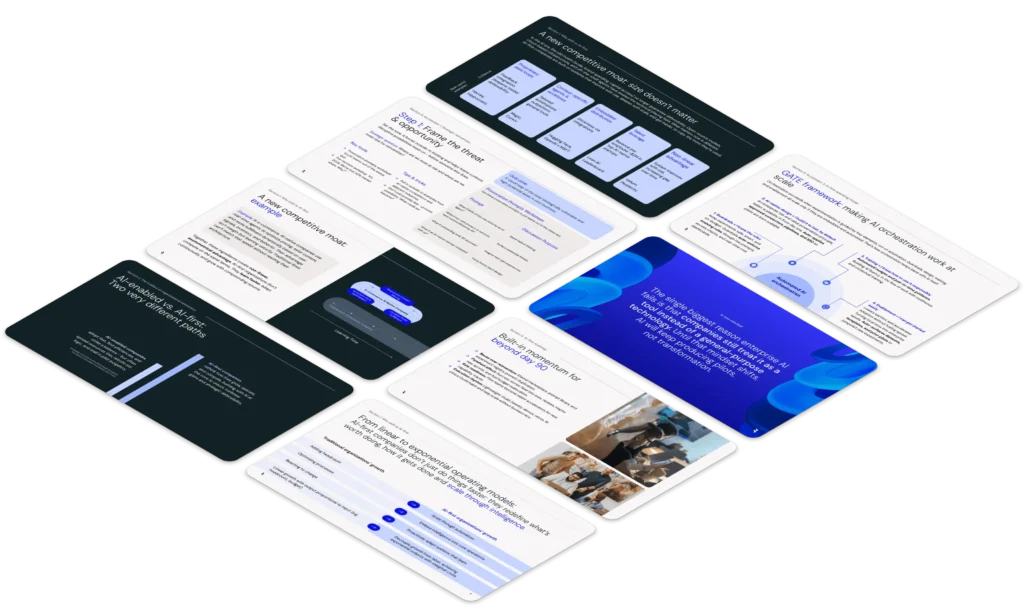
The Constraint-First AI Framework
If AI is exposing constraints rather than creating them, then leaders need a disciplined way to respond. A constraint-first approach could provide that structure.
1. Identify the true bottleneck in value creation
Before evaluating tools, clarify where growth is genuinely constrained.
- Is revenue limited by slow commercial decision cycles?
- Is innovation constrained by fragmented knowledge?
- Is operational performance constrained by coordination complexity?
The goal is to define the bottleneck precisely and quantitatively.
2. Test whether AI compresses that constraint
AI is not a universal solvent. Before committing resources, leaders must determine whether it materially compresses the constraint in question; whether it shortens decision cycles, elevates decision quality, expands personalization capacity, or enables scale that was previously impossible. If the impact on the bottleneck is marginal, the initiative will remain incremental.
3. Redesign the workflow, not just the task
If AI removes a bottleneck, the surrounding workflow must evolve. Decision rights, accountability, performance metrics and governance structures may need adjustment. Without redesign, gains remain siloed and fragile.
4. Align ownership and incentives
AI initiatives stall when ownership is ambiguous. Business leaders must own outcomes, not just technical teams. Incentives should reward system performance and impact, not just tool adoption.
5. Scale through integration
True scale requires integration across functions. Data architectures, governance frameworks and capability development must support enterprise-wide deployment. Fragmented pilots rarely lead to a sustained advantage.
A constraint-first framework shifts AI from experimentation to transformation. It forces organizations to confront the structural issues that AI makes visible. Most importantly, it turns AI into a deliberate growth lever rather than an isolated innovation initiative.
Conclusion: AI will not fix what you won’t redesign
AI is revealing whether your pilots connect to real constraints, whether your operating model can adapt, and whether leadership is willing to redesign instead of optimize.
And while the technology continues to evolve, the real question is whether you will evolve with it.
If you realign your organization around the real constraint, AI becomes a growth lever.
If you don’t, it will amplify the friction already slowing you down.
Want to explore how to make AI a growth lever? Let’s talk

Partner
Vincent is a senior leader in AI strategy and business transformation, helping Fortune 500 organizations unlock the full potential of artificial intelligence. As a Global Partner at Board of Innovation, he specializes in shaping AI-driven growth strategies for consumer goods, retail, and technology leaders across the USA and Europe. His expertise lies at the intersection of AI, business strategy, and enterprise transformation, helping senior executives navigate AI adoption and scale AI-driven decision-making. He’s focussed on helping organizations build future-ready AI strategies that deliver real business outcomes.