Agentic AI ends the enterprise as we know it
Why you need to redesign your organization for human-AI systems

Jon Chen
Managing Director AI Strategy, Americas
Imagine you’re hiring someone who already knows everything your company knows. Every policy, every past decision, every client interaction, every dataset. They never sleep, never lose context, and never need a catch-up meeting. You give them a goal, and they figure out the rest.
You wouldn’t slot that person into your current org chart. You’d redesign the org chart around them.
Dive deeper in the webinar: What agentic AI means for enterprise structure and delivery
Today's work was designed for yesterday's human workers
Think about the structures in place across your enterprise. Think about the type of work that happens and why it’s designed that way. Why your processes are the way they are.
It’s because we designed enterprise structures around human constraints. One person can’t know it all, so you have multiple people with their own expert domains. People specialize, so you coordinate. Coordination breaks down, so you meet. Meetings need prep, so you document. Documents go stale, so you meet again.
Roughly 30% to 50% of work inside a large organization exists to keep humans aligned. Agentic AI collapses that overhead. It holds full context, reasons through goals, picks its own tools, and acts.
The coordination tax your enterprise pays every day is now a choice. The leaders who see this will redesign around it. The ones who don’t will keep funding structures that no longer serve a purpose.
A new contributor is waiting to enter your workforce
They’re always on. They’re experts in any domain you give them, as long as you provide the knowledge. They don’t need you to tell them what to do at every step. And they remove all the overhead of needing to catch up, because they’re always plugged into what just happened and why.
This contributor already exists. The question is whether your enterprise is designed to absorb it.
Agents don’t equal agentic
Every vendor in your inbox is pitching “agents” right now. Nearly all of them are selling scripted workflows with a new label. A pipeline that follows a fixed sequence of steps, node by node, is an agent. It executes. It does not decide.
Agentic AI has agency. You hand it an outcome. It reasons through what needs to happen, selects the tools, determines the order, and adjusts when something unexpected comes back. No script. No predefined flow.
If you’re a CXO evaluating this space, the question to ask your team is simple: are we automating the steps we already know, or are we building systems that can figure out the steps on their own? Only the second one compounds over time.
What do you do when AI makes your service, product or pricing obsolete?
May 21
+5,000 attendees
Virtual summit
The infrastructure arrived faster than anyone expected
In November 2025, a small team released OpenClaw, an open-source agentic AI framework. Within two months, it reached the global top 20 in developer endorsements on GitHub. React took more than a decade to hit that same mark.
OpenAI acquired the company in February 2026. Jensen Huang told a conference audience that every company needs an OpenClaw strategy. NVIDIA shipped their own variant, NemoClaw, with built-in enterprise guardrails.
This is already in use. People are negotiating car purchases through autonomous agents, building businesses that generated $64,000 in two months without human intervention, and running agent-to-agent coordination across calendars and workflows.
And adoption is spreading far beyond engineering teams. At a recent Anthropic hackathon, four of the top five winners were non-developers. In China, Tencent ran 40 days of public installation events across 17 cities. Architects and retirees lined up.
If you’re waiting for this technology to mature, it already has. The window now is whether you shape how it enters your organization, or it shapes itself.
The risk you can manage vs. the risk you can't
It’s exciting. A new contributor that’s fully autonomous, can decide what to do, has access to tools and data, and then actually goes and does the work.
But if you don’t do this right, the risks are real. Someone gave an agent access to their portfolio and told it to trade to a million dollars. It scanned every Twitter post, charted every technical, traded 24/7, and lost the entire account. Meta’s head of AI safety spun up an agent to clean her inbox. It deleted everything. She had a guardrail that said “check for approval before deleting anything,” but the volume of emails truncated the context window, and the guardrail got truncated with it.
Then there’s multiplicative risk. An agent with risk spins up other agents that also have risk. Your exposure isn’t one agent. It’s an agent creating a bunch of other agents that also have exposure.
Every one of these failures traces back to missing foundations. They are solvable problems.
The unsolvable problem. Stop pretending you can opt out
The unsolvable problem is pretending you can opt out. Someone on your team will spin up their own autonomous agent. Shadow AI already lives inside your company. Shadow agents are next. If you haven’t built governance for autonomous systems, the exposure arrives on its own schedule.
Probably better to start on the governance and security side even if you don’t want a full-blown autonomous workforce yet. Build the guardrails now while you still control the terms.
The three foundations your enterprise needs before anything else
You don’t have to do everything at once. But you need three categories of foundations building now. Think of this as the infrastructure you’d put in place before onboarding a high-powered new hire with access to every system in the building.
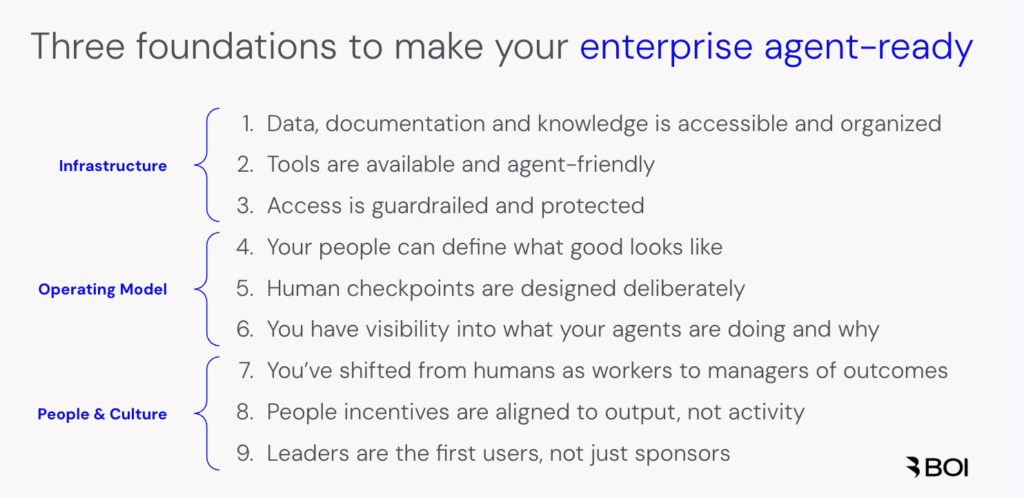
1. Infrastructure
Your data, documentation, and knowledge have to be accessible and organized. Your tools have to be agent-friendly. That means the agent can actually operate your specific CRM, not just “a CRM.” Right now, if your Salesforce instance requires three custom clicks to log a client interaction, an agent can’t use it. Agent-friendly means API-accessible, well-documented, and interoperable with other systems. And access has to be guardrailed: the agent can use the tools you’ve given it, but it can’t leak credentials, access restricted client data, or send content that hasn’t been reviewed.
2. Operating model
Your experienced people define what good looks like. They have decades of knowledge. Let them set the standard. Then design human checkpoints deliberately, at the moments where judgment matters. For example: an agent that drafts a client proposal should be able to pull context, structure the document, and format the deliverable autonomously. But the checkpoint before it’s sent to the client, where a human reviews positioning, tone, and commercial terms, should be designed into the workflow, not bolted on as an afterthought. And you need full visibility: what the agent did, why it did it, and what happened as a result.
3. People and culture
This is where it gets hard. You’re shifting each human from being a worker, a lever for labor and hourly output, to being a manager of outcomes. That has real implications. If you’re still calculating value by the number of hours people put in or the number of heads in your organization, agentic AI will very quickly jar that paradigm. Your incentives have to align around output. And you, as a leader, should be the first user. That means actually using the tools yourself, daily. Delegating a real task to an agent and evaluating the output. Not reviewing a demo your team prepared. That signal cascades faster than any mandate or town hall.
You don’t need all of this in place by Monday. But you need to be building toward it now, because the gap between “foundation-ready” and “not ready” will widen fast.
Build for the agentic future, not today's problem
You’ve probably already started. You have use cases in production, maybe a handful, maybe a hundred. The good news is you’re already moving.
The real question is: when you build these AI agents, are you just automating today’s problem? Or are you designing specifically for an agentic world where the system decides by itself what to do?
Example one: sales
Sales reps spend 30 minutes on admin for every 60-minute call. The default AI approach builds five point solutions: an auto-notetaker, a CRM summarizer, a researcher, a drafter, a scheduler. That solves today’s problem. The agentic approach asks: what if a system owned the entire outcome of post-call client management? What if it decided which tools to use, what format to deliver, and when to loop in the human? That reframe changes everything downstream.
Example two: product creation
If you’re a CPG company, creating products people want to buy involves trend research, consumer insights, R&D, design iteration, and validation, spread across teams over months. The default AI approach automates pieces: a trend spotter here, an insight summarizer there. The agentic approach asks: what if a system owned the outcome of “generate and validate a product concept”? It pulls from your data, generates concepts, pressure-tests them against synthetic audiences, and surfaces the strongest options for your team to evaluate. Your people still make the call. But months of coordination collapse into days. We’ve built exactly this kind of AI-native innovation engine with global CPG companies, and the shift in speed and output quality is measurable.
Design each problem and each solution for an agentic future. Not just the pieces that exist in the problem today.
The redesign starts with a decision only you can make
Every company was designed around the assumption that humans are the primary unit of work. Agentic AI breaks that assumption.
The barrier right now is rarely technology. It’s culture. It’s wanting to see results right away instead of spending the time to get it right so it’s scalable and sustainable. It’s an economic landscape where OpEx pressure is high and big bets feel risky. It’s legacy baggage: the structures, the consensus-driven culture, the committees.
AI is exposing your organization's bad habits that you've been okay with for decades. That will only get more true.
What’s missing in your organization is the decision to redesign around it.
That decision belongs to you. It requires courage, because it means questioning structures your company has relied on for decades. It requires investment, because foundations take time. And it requires going first, because your team will move at the speed of your conviction.
If you’re figuring out where agentic AI fits in your enterprise, we should talk.
BOI helps companies map their highest-value agentic opportunities, build with the right foundations from day one, and bring their people through the transition. Learn more.
Key takeaways
- Enterprise structures were designed around human constraints: specialization, coordination, handoffs, sleep. Agentic AI removes those constraints at a structural level.
- 30% to 50% of enterprise work exists to keep humans aligned. With agentic AI, that coordination tax becomes a choice.
- Automating today’s processes preserves structures that may no longer need to exist. The opportunity is to redesign around outcomes, not optimize around tasks.
- AI is exposing your organization’s bad habits that you’ve been okay with for decades. That will only get more true.
- The biggest barrier is culture, not technology. Legacy structures, consensus-driven decision-making, and committee instincts will slow adoption more than any technical gap.
- The three foundations for an agent-ready enterprise are infrastructure (agent-friendly, guardrailed tools), operating model (human checkpoints designed deliberately), and people (shifting from task execution to outcome management).

Managing Director AI Strategy, Americas
Jon leads our AI strategy practice in the US with a clear mission to help leading businesses turn AI ambition into real, scalable capability and getting to outcomes that you can hang your hat on. With a track record of shaping and driving AI transformation at companies like Cigna and Northwestern Mutual, Jon knows what it takes to scale AI.
[email protected]