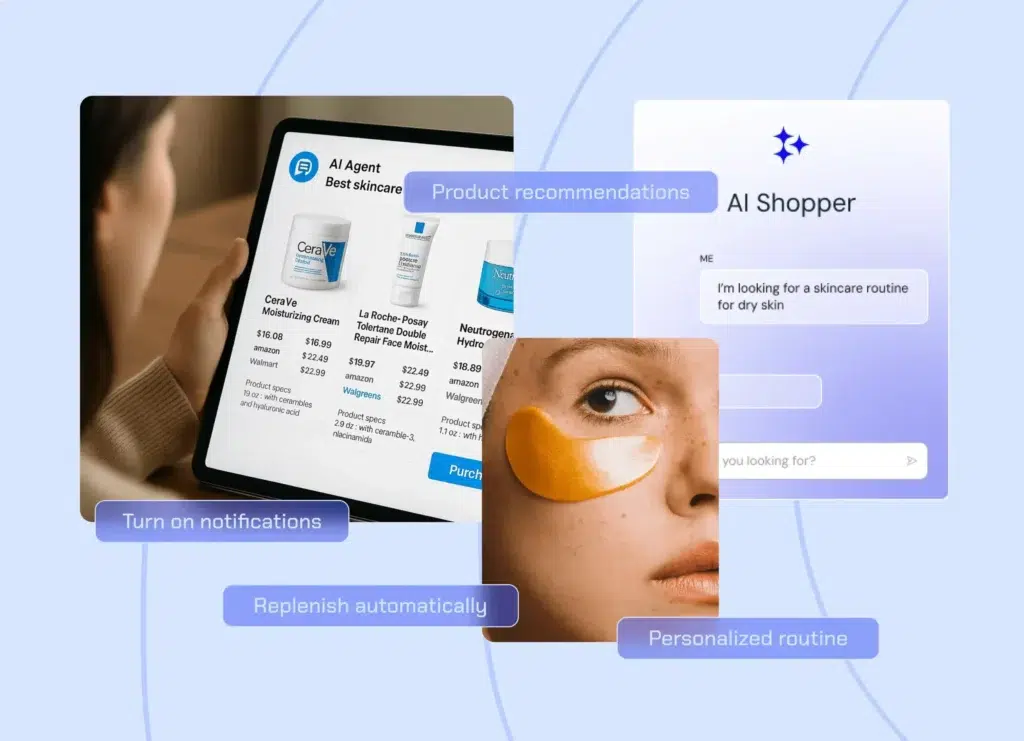
Advertising is coming to AI. What it means and how to prepare

Jonas Keersmaekers
AI Growth Director
A fundamental shift in how value is created and captured is underway.
Much of what follows is not yet formalized, but the signals from platform roadmaps, early monetization experiments, and agentic product design patterns point in a clear direction.
Most leadership teams have added AI Optimization (AIO) to their marketing and growth roadmap.
They’ve realized that if they aren’t visible in the “answer engine” layer, they don’t exist.
But as the agentic economy takes shape, we need to address the elephant in the room: the introduction of advertising. AIO is defensive, advertising is offensive.
We should be candid: few people are actively rooting for the arrival of advertising within their clean, quiet AI interfaces, as exemplified best by Anthropic. There is a legitimate concern that the ‘reasoning’ we’ve come to rely on could be compromised by the highest bidder. However, as we move from the experimental phase to a full-scale ecosystem, monetization is the inevitable friction that funds the infrastructure of the agentic age.
As the infrastructure of the agentic economy matures, we are entering a more provocative phase: The monetization of the reasoning layer.
At BOI, we don’t view this as “Search 2.0.” We view it as a rewiring of the growth engine. The first wave of AI drove productivity. The second improved discovery and decision-making. The third is about building entirely new value models—agentic commerce being one of the first to emerge.
The shift: from clicks to contextual insertion
Traditional SEO was about winning a blue link. AIO is about being part of the summary in various LLMs. But the next step: “Agentic Advertising”, is about influencing the intent before the summary is even generated.
When a user asks an autonomous agent to “Plan a zero-carbon business trip to Tokyo,” the opportunity for brands isn’t a banner ad on the side of the screen. It is being the verified, preferred entity that the LLM selects because your brand has successfully integrated its “trust signals” into the model’s recommendation logic.
Three layers of agentic commerce
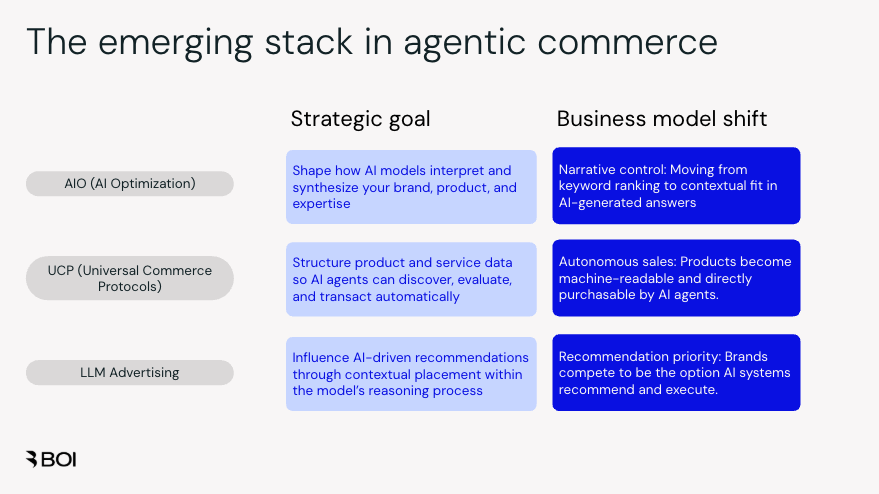
To lead in this new landscape, companies must move beyond traditional marketing tactics toward what we can call a protocol-first strategy: structuring your data, products, and signals so AI systems can discover, understand, and transact with them directly.
Three emerging layers will shape how brands compete in an AI-mediated economy: narrative influence, machine-readable commerce, and recommendation priority.
AIO (AI Optimization): Control the narrative
Ensure AI models represent your brand correctly in generated answers.Universal Commerce Protocols (UCP): Enable the transaction
Structure product data so AI agents can buy and sell autonomously.LLM Advertising: Influence the decision
Compete to be the recommended option within AI-driven purchasing flows.
Together, these layers point to a new reality: it’s no longer just about being visible to people, but about being understood and trusted by machines.
The trust gap: pay-to-play isn't enough
In an LLM-mediated world, the highest bidder doesn’t automatically win. These systems are designed to prioritize reliability and usefulness. If a brand pays for placement but lacks strong entity trust (verified data, credible documentation, and consistent authority across sources) the model may still deprioritize it.
As a result, growth in LLMs will increasingly rely on two complimentary inputs:
- The quantitative input: Paid placement via upcoming LLM ad protocols.
- The qualitative input: Deep, machine-readable context hubs that prove your brand is the most logical choice.
How to prepare
We are at a critical moment for experimentation before standards and protocols fully lock in.
Three moves to start today:
- Move from creative to context: Stop (only) optimizing for human eyeballs and start optimizing for AI understanding. Ensure your technical documentation, sustainability reports, and pricing data exist in formats that LLMs can easily verify and interpret.
- Audit your agentic funnel: Use a “secret shopper” approach with LLMs. Ask Claude, Gemini, and Perplexity to solve a complex problem in your category. If you aren’t the primary recommendation, you have an entity problem, not a media-spend problem.
- Prepare for zero-click conversions: When advertising moves inside the LLM, in whatever form, the website becomes secondary. Ensure your checkout and lead-gen systems are ready to be compatible with emerging protocols like UCP.
Why this is a business model challenge, not just a marketing challenge
We are entering a window of opportunity to rethink the funnel. When an LLM becomes the primary interface between consumers and the market, the traditional funnel (awareness, consideration, conversion) collapses into a single interaction: the prompt.
Instead of guiding users step by step through a journey, brands must compete inside the AI’s decision process itself.
This creates two immediate strategic imperatives:
1. From keyword bidding to recommendation priority
In an agentic economy, companies won’t just compete for keywords, they will compete to be the recommended option. If an AI assistant is authorized to make purchases on behalf of a user, being the second recommendation may be effectively the same as being invisible.
2. From clicks to entity trust
LLMs are designed to prioritize reliable and useful answers. Paid placement alone won’t guarantee visibility. Brands will need strong entity trust verified data, credible documentation, and consistent signals across sources.
Brands must build trust hubs: deep repositories of verified data that models can ingest to validate their paid claims.
The bottom line
The arrival of advertising within LLMs will trigger the most significant reallocation of marketing spend since the birth of Google Adwords. But the winners won’t be those with the biggest budgets, they will be the brands that understand how to navigate the reasoning layer.
Is your growth engine ready for the agentic economy? Let’s talk