Agentic Commerce is the first real test of AI’s power

Laura Stevens
Managing Director of Data & AI
Every major technological revolution reaches a point where it stops being a feature and becomes the foundation. Agentic Commerce is the first glimpse of that future, where AI no longer fits into the system, but becomes the system.
Every revolution has a moment when the tool disappears and the transformation begins. This is that moment for AI.
AI is at an inflection point
That’s what makes it so powerful, in my view: it reframes the narrative of AI, from a tool that fits into existing workflows, to a transformative force that reshapes how we think, act, and build. That’s why we’ve made it central to our mission: helping people accelerate into a deeper understanding of AI’s true power and how to capture it.
But seeing that shift always takes time. When new technologies emerge, we instinctively interpret them through the lens of what we already know. We apply yesterday’s mental models to tomorrow’s realities. It’s human, but it’s also why most organizations miss the early moments of transformation.
As many thinkers have noted, the defining skill of this century won’t be learning, but unlearning and relearning. History has a way of separating those who are truly thinking from those simply operating in default mode.
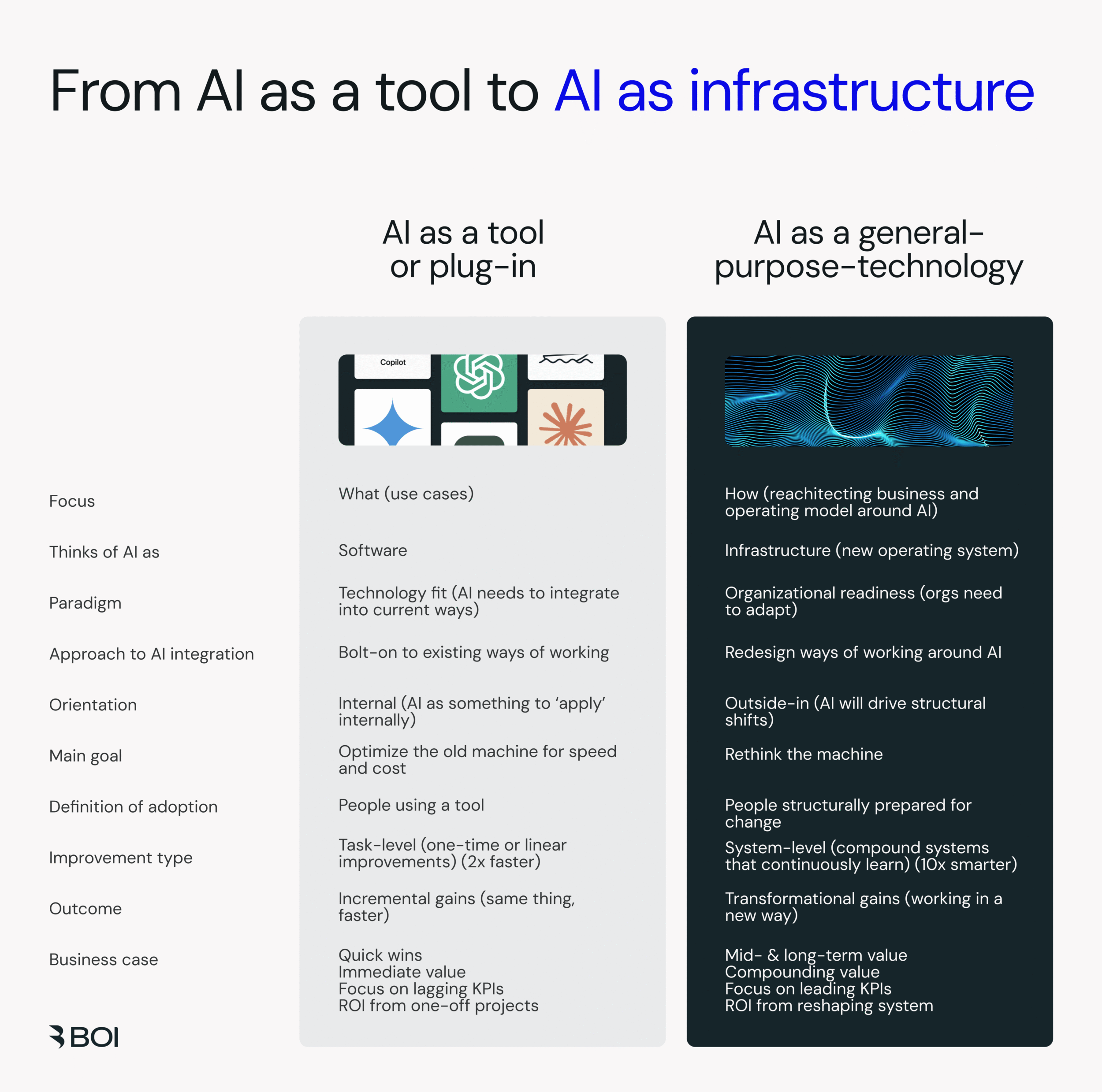
AI now stands at that same inflection point. While most companies are still using AI to make yesterday’s system run faster, we’re seeing the first group of leaders beginning to realize that the real breakthrough doesn’t come from plugging models into existing systems but from rearchitecting the organization itself: its workflows, its decisions, its assumptions.
The overview below details the inflection point: AI as tool vs. AI as infrastructure
Agentic Commerce: When AI becomes the market itself
What is Agentic Commerce?
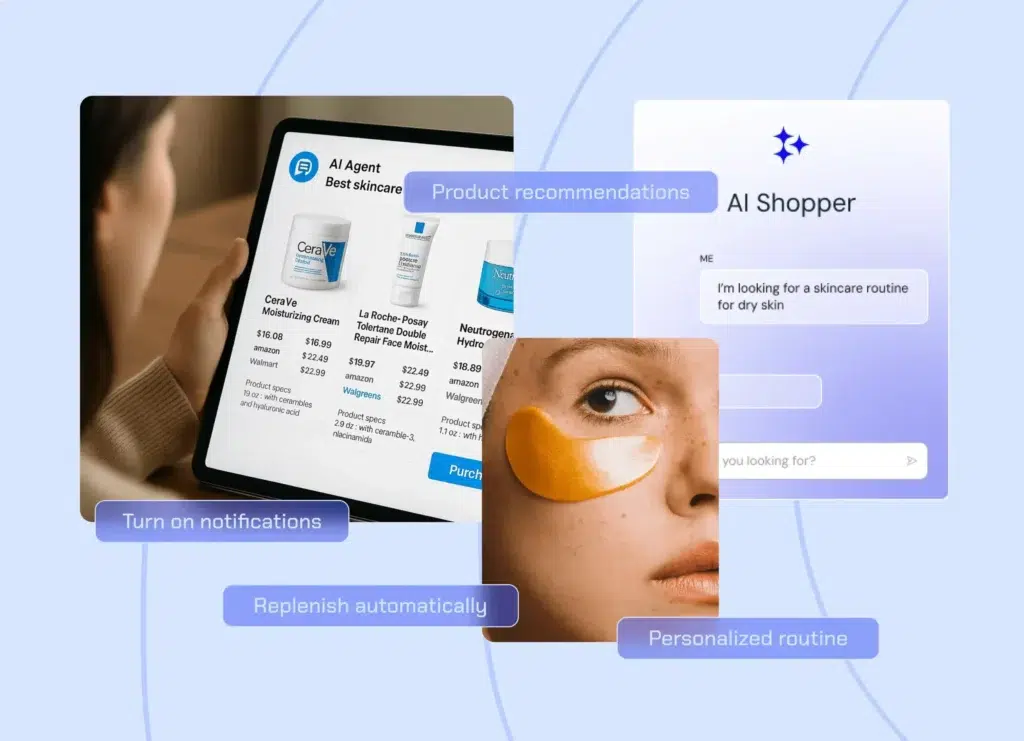
Agentic Commerce is enabling AI-driven agents to act on behalf of consumers or businesses to handle the entire shopping journey: from discovery and comparison, to negotiation and purchase. Often without intervention from humans.
And it’s rapidly impacting not only retail, but the entire value chain.
AI as a lived infrastructure
Agentic commerce is the first domain where the true nature of AI as a general-purpose technology is no longer theoretical but becomes lived infrastructure. AI is becoming the foundation of commerce.
When autonomous agents can discover, evaluate, negotiate and transact on behalf of humans, the very logic of exchange starts to change. As LLMs mediate how consumers discover products, they could become the new gatekeepers of online demand. E-commerce players risk losing control over their visibility and margins, unless they adapt early through AI-optimized content, partnerships and data-sharing strategies.
That shift is not abstract. It changes how companies design, market, and operate today.
How agentic commerce changes how companies design, market and operate
- The customer journey compresses from a multi-touch funnel into a single, agent-executed decision node.
- Traditional channels (web, app, CRM) need to evolve into real-time, interoperable data surfaces that agents can read, reason over, and act on.
- Content and metadata need to serve two audiences: humans and machines. That means rethinking semantic structure, layout and logic for machine consumption.
- Consumer insights teams need to understand not only the end user, but also the diverse behaviors of agent intermediaries, including how preferences differ across model providers (e.g. ChatGPT vs. Claude vs. Perplexity).
- Sellers will need to optimize not just for people, but for agents, fine-tuning how products are interpreted, ranked, and selected across AI environments.
- New sales tactics will emerge to lower friction and increase agent-mediated conversion, including:
- Try-before-you-buy models built for agent risk evaluation
- Micro-subscriptions that make recurring purchases default
- Agent-managed returns that reduce buyer hesitation within chats
Internal operations are also impacted
- Decision-making structures, org design and governance models will need to adapt to workflows where AI is no longer a tool, but a co-actor.
- Customer identity will evolve from static demographic profiles to real-time interaction contexts, often shaped by agents negotiating on behalf of users.
AI is rewriting how markets form, interact, and evolve.
This is what marks AI as a true general-purpose technology: it doesn’t slot neatly into your business, it forces your business to adapt to it. It creates entirely new ways of working, and in doing so, exposes the limits of the old ones.
Beyond the “What”: Shifting from use cases to system design
For most organizations, the AI conversation has (so far) revolved around the what:
- What use cases should we prioritize?
- What processes can we automate?
- What models should we build or buy?
Agentic commerce makes clear that these are no longer the only right questions. Because once AI becomes an active participant in your market, the real strategic challenge shifts to the how:
- How do we rearchitect our business and operating model to let AI do what it’s best at?
- How do we redesign workflows, governance and decision rights for a world where agents act autonomously?
- How do we build the data, trust and interoperability foundations that allow AI systems to transact safely and at scale?
These are existential questions.
The question changes from ‘What can AI do?’, to ‘What does AI change about how we work?’
Agentic commerce creates a new logic of growth and competition
Agentic commerce also alters how companies grow and compete. Traditionally, growth was driven by visibility and persuasion: getting customers to find you, remember you, and choose you. In the agentic era, those dynamics invert. You no longer compete for human attention; you compete for machine inclusion.
Brand visibility is determined not by advertising reach but by data quality, structure and trustworthiness. Competitive advantage comes less from scale and more from integration, i.e. how deeply and reliably your systems connect into the broader network of intelligent agents.
In this world, agility replaces size as a survival strategy. Product catalogs must be machine-readable, content must be semantically rich, and payment systems must be agent-agnostic. Companies will need to master “algorithmic distribution,” ensuring their offerings are interpretable and preferred across multiple model ecosystems.
And as in every general-purpose revolution, the winners will be the ones who relearn fastest, who can reimagine their roles, their interfaces, and their sources of value in a system where AI mediates every transaction.
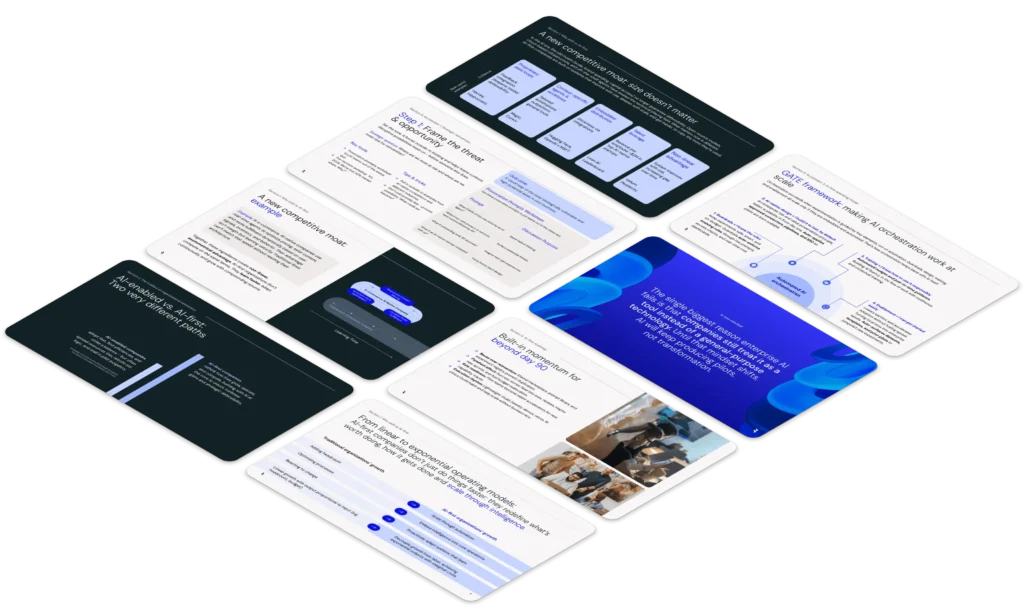
A practical playbook and 90-day roadmap to build an AI-first business that operates, learns, and grows with AI at its core.
We need to relearn how to compete
True transformation begins when established systems are redefined and we let go of the old. The same is true here: the real work in agentic commerce is redesigning how value is created, how decisions are made, and how work flows between humans and machines.
That requires confronting uncomfortable questions:
- What happens when decision-making moves beyond your walls?
- How do you govern relationships between your AI and someone else’s?
- What becomes of brand, loyalty, and differentiation when your “buyer” is a model prioritizing logic over emotion?
These are strategic design choices. They force leaders to shift from asking, “What can we automate?” to “What does this technology make newly possible and what does it make obsolete?”
The hard part is unlearning asummptions
Agentic commerce brings that inflection point into focus. It shows us that AI is not just another tool to manage, it’s a restructuring force. It’s no longer about how many AI projects you launch, but how deeply you rework decision flows, trust mechanisms and execution models for a world where agents operate alongside people.
This is where AI becomes part of the underlying structure, something the organization runs on instead of something it occasionally uses.
Keen to explore how to rearchitect your organization for the agentic era? Drop us a note.

Managing Director of Data & AI
Laura Stevens, PhD, is the Managing Director of Data & AI, bringing a unique blend of strategic vision, analytical expertise, and leadership acumen. With a background in neuropsychology, business consulting and organizational transformation, she has successfully navigated a career spanning academia, consulting, and industry leadership. As a former VP Data & AI in an international organization, Laura has led large-scale Data & AI teams covering data science, machine learning, data engineering, data governance, and visualization. She is passionate about leading organizations through their data & AI transformation.