
The short answer is no.
Despite fast progress, what we perceive as intelligence, reasoning, or personality in today’s AI, is not due to smarter systems, but to highly sophisticated pattern matching.
For business leaders, this distinction matters. It affects the reliability, scalability, and economics of every AI initiative – from copilots and agents to end-to-end transformation. Understanding what today’s AI can truly do, and what it can’t, is no longer purely a technical concern; it is a strategic one.
In this article, we examine the current state of artificial intelligence and outline the kind of progress that can realistically be expected in the coming years, and what it means for business leaders. We argue that AI is presently in a phase of incremental evolution, and moving beyond this stage will require a fundamentally different approach. For businesses, this implies that – during a phase that may last for years – meaningful value will not come primarily from better models, but from smarter system design, orchestration of human and AI collaboration, and more realistic expectations about what AI can and cannot do.
Can we expect the same pace of progress in the coming decade?
Over the past decade, AI has made extraordinary leaps. We have moved from early language models that struggled with coherence to frontier systems, such as ChatGPT, Gemini, Claude, that solve graduate-level exams, write complex code, and reason across diverse domains. By 2025, benchmarks show models operating at or above expert human levels on many classical reasoning tasks.
This progress has been built on a very specific type of neural network: transformers. Their ability to learn context at scale has proved to be an extraordinary foundation for language, code and vision models. Building on these foundations, the world is being disrupted by the vast opportunities that their applications open up.
However, as investments pour in and valuations soar, we must ask: Can we expect the same pace of progress in the coming decade? We believe that while transformers have provided an incredible foundation, building AI that plans and orchestrates reliably will require a fundamentally different approach.
Why the progress matters for leaders
Understanding how today’s systems work changes how leaders should invest, design, and scale AI across the organization. Five implications stand out:
1. Modular, human-in-the-loop systems will outperform end-to-end automation
AI systems that appear autonomous rely on fragile chains of prompts, retries, and verification. In practice, they break under edge cases and scale poorly. Systems that clearly separate perception, reasoning, verification, and execution (and deliberately keep humans in the loop at critical decision points) are more reliable, easier to govern, and faster to improve.
2. AI transformation is a system design challenge, not a tool or model selection problem
Impact comes from orchestration: how models are combined with tools, workflows, guardrails, and human oversight. Organizations that focus primarily on choosing “the best model” will fall behind those that invest in system redesign and AI-first operating models.
3. Inference costs will determine what scales and what fails
Many advanced AI capabilities depend on expensive inference-time reasoning: long chains of thought, multiple retries, and self-verification loops. These costs compound in production. Leaders need to treat inference cost, latency, and reliability as first-class design constraints, not technical afterthoughts.
4. Structuring AI for dependable execution
At the current state, AI excels at applying known patterns at scale, not at inventing new strategies or managing open-ended complexity. The highest returns come from well-scoped use cases where AI operates within clear boundaries, supported by human judgment rather than replacing it.
5. Realism beats hype
AI is in a phase of incremental evolution. Breakthroughs in reasoning will require scaling different architectures to today’s AI models. Organizations that align expectations with reality, focusing on pragmatic value creation today while preparing for future shifts, will outperform those betting on near-term artificial general intelligence.
The success - and limit - of scaling
The recipe for success of the past decade was based on scaling along three dimensions: 1) data; 2) computer power and 3) parameters. The financial trajectory of this scaling is steep: training costs for frontier models have surged from thousands of dollars in 2016 to an estimated $500M for top 2025 models, such GPT5.2 by OpenAI, Gemini 3 by Alphabet or Claude Opus 4.5 by Anthropic.
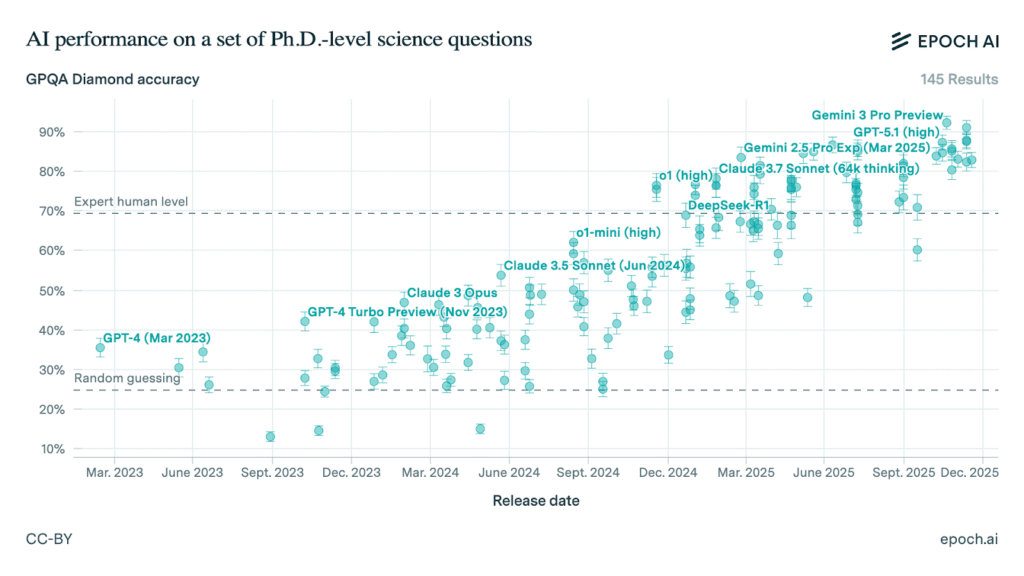
So far, performance has surged together with investments. Results of the GPQA Diamond test, which measures AI’s ability to answer hard scientific questions, requiring reasoning and calculation, show that frontier models perform better than average PhD’s since the end of 2024 (see figure below from Epoch.AI).
But, despite continued investment, progress is stagnating. New frontier models exhibit minor performance differences, suggesting the performance gains stem from better coverage of reasoning patterns in training data rather than qualitatively new reasoning capabilities. Benchmarks targeting multi-step reasoning, such as PlanBench, confirm that even simple tasks akin to solving a Rubik’s cube remain difficult for current models. These tasks require long-range reasoning, and unless seen in training data, transformers are not able to solve them.
Note on vision and robotics
Vision models are architecturally similar to language models, despite their currently faster rate of progress. This steeper development trajectory for vision models is because they are earlier in the scaling curve; therefore, increases in data, computing power, and parameters still account for the majority of their performance improvements.
Robotic systems differ fundamentally from end-to-end transformer models in their structure and constraints. They are modular by necessity, relying on separate components for perception, prediction, planning, and control to meet real-time and safety requirements. While transformers are increasingly used within these stacks, they function as components rather than as the system itself, operating within broader hybrid architectures.
Robotics provides a useful counterfactual to the current trajectory of language models. Unlike LLMs, robotic systems could not rely on end-to-end scaling and inference-time reasoning: real-time constraints, safety requirements, and interaction with the physical world forced early adoption of modular architectures, explicit state representations, and internal planning. As a result, robotics has long treated perception, prediction, planning, and control as distinct problems – each optimized for efficiency and reliability.
From training to inference: where progress is now coming from
As training returns diminish, the frontier has shifted from better base models to clever inference-time tactics.
Today, AI “reasoning” is achieved through:
- Multi-step planning and execution: Utilizing extensive chain-of-thought traces to manage and complete complex, multi-step tasks.
- Verification and self-correction: Incorporating loops for self-reflection and validation to ensure accuracy.
- Tool orchestration: Employing agentic abilities to integrate and manage various external tools, such as web browsers.
Building these capabilities requires an increased focus on training techniques with human intervention, such as supervised fine-tuning (SFT) and reinforcement learning with human feedback (RLHF), and development of specific run-time logic for sophisticated multi-step analysis. These efforts improve substantially the performance – but lead to a significant increase of training and run-time costs. Indeed, applying these tactics requires generating a large number of tokens (words) at inference time – leading to ever larger outputs.
Is inference-time reasoning scalable?
This is where a structural problem emerges. Training with human supervision or feedback and inference-time reasoning scale poorly:
- SFT and RLHF depend on costly and scarce human input, making further gains increasingly expensive and difficult to scale.
- Inference-time reasoning incurs compute costs that grow linearly (or worse) with reasoning depth, number of attempts, and use of search or reflection.
Economically, this differs fundamentally from training-driven progress: training costs are largely one-time capital expenditures, whereas inference costs are operational and compound with usage. As a result, models that rely heavily on long chains of thought, reflection, and search become significantly more expensive to deploy at scale, making inference economics a central consideration in any realistic business case for AI transformation.
We have to distinguish between the cost of a token and the cost of a task. Even as hardware efficiency makes individual tokens cheaper, reasoning models use so many more of them that the total bill remains high. It’s a classic Jevons Paradox: as intelligence gets cheaper, we don’t save money – we just use more of it to solve harder problems. This makes ‘inference economics’ the real bottleneck for AI adoption, shifting the focus from how a model is trained to how much we can afford to let it ‘think.’
AI model development today relies on building increasingly complex structures on top of the same transformer foundation. Each additional layer of reasoning logic improves performance – but at rising marginal cost and complexity. At this stage, much of what we call “progress” looks less like new intelligence and more like fine-tuning, scaffolding, and orchestration around a fixed core.
Are we really fine-tuning intelligence?
Yes.
Transformer architectures are extraordinary at compressing information, but their ability to generate genuinely new reasoning patterns is limited to interpolations of structures present in their training data. In other words, transformers generalize by recombination, not by invention.
This means that teaching new reasoning patterns requires providing explicit examples. Then, the machine learns to reproduce these patterns and combine them with already known patterns.
Recombination is very valuable, and a lot of benefits remain to be captured for businesses. But as it is now, AI cannot reliably replicate human reasoning and their ability to execute complex tasks independently.
How does this compare to human intelligence?
We do not know everything about human reasoning, but we know that they learn, and think, differently than present day transformers.
Humans learn procedures, not just patterns
Humans infer rules from examples and apply those rules far beyond the seen examples. Transformers learn patterns and generate new patterns through recombination – but they are unable to infer rules.
An example is addition: once learned, humans are able to add numbers of arbitrary length, whereas transformers often fail outside the training regime.
Humans learn from very little data
A consequence of humans ability to learn procedures, is the ability to learn from a very limited number of examples. This is in stark contrast to transformers, that need thousands to millions of examples before being able to reproduce a pattern.
Humans reason causally, not correlationally
Human learning is grounded in causal models (if this then that), counterfactual reasoning and intervention (what if … ?). This allows us to transfer knowledge across domains, do robust planning and generalize explanations in a way that is inaccessible to transformers. Indeed, transformers exclusively learn correlations.
Human reasoning is iterative, adaptive and goal-directed.
We naturally allocate more effort to harder problems, change strategy mid-way and decompose problems.
Transformers “reason” by recursively generating tokens and are unable to internally revise earlier steps unless explicitly prompted to. Furthermore, given the recursive generation approach, it is statistically hard for them to “change strategy mid-way”: once fixed on reproducing a pattern, they stick to it. And they are unable to decompose problems otherwise than reproducing decompositions seen in training data.
Humans invent as transformers cannot
The above human capabilities allow humans to invent and discover as transformers will never be able to. We are able to discover mathematical proofs, invent new heuristics thus activating new, reliable, thinking shortcuts just by reasoning, and generalize methodologies to unknown domains. All these are rare, and require considerable effort and concentration, but it happens.
Transformers, on the other hand, only reason through interpolation and recombination, in ways that are statistically fixed by the training data and input prompts. That is, transformers are not able to think out of the box.
System 1 vs System 2 thinking
Essentially, the comparison between human and machine can be understood through the lens of Daniel Kahneman’s framework of System 1 and System 2 thinking – System 1 being fast, intuitive thinking, and System 2 being purposefully deep and abstract thinking. Transformers are fundamentally System 1 engines: they excel at fast, intuitive, and associative pattern matching. The AI industry’s current pursuit of ‘reasoning’ is essentially an effort to simulate System 2 by enriching System 1 outputs through verification steps, Chain of Thought, and tool use.
What does this mean for AI transformation in organizations?
For business leaders, the most important implication is to recalibrate ambition and execution around a realistic view of how AI is likely to evolve. In the near to medium term, progress will be largely incremental: models will become somewhat better, cheaper, and more accessible, but not fundamentally different in kind. Transformation strategies should be designed to compound value under these conditions, rather than bet on imminent breakthroughs.
1. Treat AI as a force multiplier, not a strategist
First, AI should be treated as a force multiplier for what organizations already know how to do well. Current systems are not positioned to invent genuinely new strategies, operating models, or business logic from first principles. Their strength lies in scaling known best practices: standardizing decisions, accelerating execution, improving consistency, and extending expertise to more people at lower cost. Leaders should therefore start from proven processes and ask where AI can increase speed, reach, quality, or reliability – rather than expecting it to redefine the business on its own.
2. Redesign workflows around human-AI collaboration
Second, workflow redesign requires particular care. Delegating tasks to AI is relatively easy; delegating responsibility is not. In complex, multi-step, and unpredictable operations, fully AI-driven workflows will underperform with today’s technology. Failures tend to emerge not from single-step errors, but from compounding mistakes, loss of context, and brittle handoffs between steps.
Competitive advantage will instead come from deliberately designed human-AI operating models, where:
- AI removes administrative and cognitive overhead (documentation, retrieval, summarization, coordination).
- AI enriches decision-making by surfacing context, options, risks, and trade-offs.
- Humans retain ownership of judgment, prioritization, and accountability, while being elevated to higher-value work.
3. Invest in system design, not model chasing
Third, leaders should invest less in “model chasing” and more in system design. As long as AI progress remains incremental, most value will be captured by organizations that integrate AI deeply into their processes, data flows, and incentives.
This includes:
- Designing clear interfaces between humans and AI (who decides what, when, and based on which signals).
- Building feedback loops so human corrections improve system behavior over time.
- Ensuring data quality, governance, and observability, which matter more than marginal model improvements.
4. Build organizational capability, not just technology
Finally, expectations and capability building matter. AI transformation is not primarily a technology rollout; it is an operating model change.
Leaders should focus on:
- Training managers and frontline teams to work effectively with AI outputs, including understanding limitations and failure modes.
- Measuring success in terms of business outcomes and adoption, not technical sophistication.
- Being explicit about where AI is advisory versus authoritative, to avoid both over-reliance and underuse.
In short, organizations should optimize for durable advantage under incremental progress: scale what already works, redesign workflows around human–AI collaboration, and invest in systems, governance, and skills rather than hoping for near-term leaps in machine intelligence.
What progress requires: shifting to internal computation
The contrast between human and AI reasoning points to clear directions for progress beyond current transformer-based systems. Achieving more scalable and generalizable reasoning will require moving from pattern compression toward the ability to learn and execute procedures. In practical terms, this means shifting reasoning from expensive inference-time token generation to efficient internal computation.
- Adaptive and recurrent computation: Future systems will need adaptive computation, allocating more effort to hard problems and stopping early on simple ones, to reduce reliance on long chains of thought and repeated sampling.
- Explicit internal state and memory are essential for planning, causal reasoning, and long-horizon consistency.
- Training objectives beyond next-token prediction: Objectives that reward correctness, consistency, and compositionality are required to internalize reasoning rather than reconstruct it at inference time.
- Hybrid and modular architectures: Coordinating specialized components (e.g. language, mathematics, planning, verification) offers more reliable and efficient reasoning than monolithic models.
- Efficient tool use and better evaluation: Tool use should reduce, not inflate, inference cost, and benchmarks must distinguish genuine reasoning improvements from gains driven by increased inference compute.
Notably, many of these directions – explicit state, internal planning, modularity, and learned world models – are not speculative: they are already standard practice in robotics, where end-to-end inference-time reasoning was never economically or operationally viable. One may expect that language and vision models and robotics will converge in the future. After all, this is how humans operate.
Why the next breakthrough can’t compete yet
Despite growing recognition among researchers that progress in AI may require moving beyond transformer-based architectures, the field appears locked into a local minimum. Transformers are extraordinarily powerful, heavily optimized, and supported by unprecedented levels of capital and infrastructure. They dominate benchmarks, production deployments, and research incentives alike.
A self-reinforcing cycle
This success creates a self-reinforcing dynamic.
As more capital flows into transformer-based systems, they improve faster – not only because of scale, but because of accumulated tooling, data pipelines, evaluation frameworks, and deployment experience. Any alternative approach must now compete with systems trained using hundreds of millions of dollars in compute and refined across dozens of benchmarks, products, and feedback loops. Clearing that bar is no longer an academic challenge; it is an industrial one.
The investment asymmetry
The consequence is an asymmetric risk profile. For investors and organizations, funding incremental improvements to transformers is the rational choice: the path is well understood, the upside is near-term, and the market validation is immediate. By contrast, investing in fundamentally different approaches – architectures, learning paradigms, or representations – carries long time horizons, uncertain metrics of success. Even if such approaches are promising, they are difficult to justify in a landscape dominated by short-term performance comparisons.
The paradox of dominance
This produces a paradox. The very success of transformer-based AI raises the barrier to discovering something better. As systems grow larger and more capable, the entry cost for competing ideas rises, not because those ideas are less sound, but because they must prove superiority against an increasingly optimized incumbent. What once required a small research group now demands capital, infrastructure, and patience on the scale of major industrial labs.
This pattern is not new
History shows that this pattern is not unique to AI. In aviation, decades of investment in propeller technology delayed the adoption of jet engines, despite clear physical advantages. In computing, early dominance of specialized hardware and instruction sets slowed the transition to general-purpose architectures. Many more examples can be found, spanning all scientific disciplines. In each case, progress eventually came not from pushing the dominant approach to its absolute limit, but from reframing the problem and accepting short-term inferiority in exchange for long-term gains.
AI is at a similar juncture
Transformer-based systems continue to improve, but increasingly through expensive inference-time scaffolding and human intervention rather than through scalable gains in internal reasoning. This suggests diminishing returns along the current trajectory. Escaping the local minimum will likely require tolerating approaches that initially underperform on existing benchmarks, redefining what success looks like, and investing in paradigms that prioritize efficiency, adaptability, and internal computation over brute-force scale.
The real risk - and the opportunity
The risk, if we fail to do so, is not stagnation but misallocation: a future in which enormous resources are spent extracting incremental capability from a mature paradigm, while more fundamental advances remain unexplored. The opportunity, conversely, lies in recognizing that today’s dominant architecture may be a powerful waypoint rather than a final destination – and that genuine breakthroughs often emerge only once a field is willing to look beyond what currently works best.
How leaders win without waiting for breakthroughs
AI has not entered an age of reason, and there is little evidence that it will do so in the near future. What we are witnessing instead is the steady refinement of powerful pattern-matching systems: increasingly capable, increasingly useful, but fundamentally constrained. For business leaders, the implication is not to slow down AI adoption, but to pursue it with greater precision and discipline.
1. Reset expectations
The first directive is to reset expectations. Transformation strategies built on the assumption of imminent, qualitative leaps in AI capability will underdeliver. Leaders should plan for incremental progress and design initiatives that generate value even if models improve only marginally. The organizations that win will be those that compound small gains through scale, integration, and learning over time.
2. Focus on operating models, not autonomy
AI should not be positioned as an independent decision-maker in complex, dynamic environments. Instead, leaders should deliberately design human–AI collaboration, using AI to absorb administrative load, expand situational awareness, and surface better options – while keeping humans accountable for judgment and outcomes. Competitive advantage will come from elevating human performance, not replacing it.
3. Invest where differentiation actually emerges
Model choice will matter less than system architecture, data quality, governance, and feedback loops. Leaders should prioritize end-to-end process redesign, clear decision rights, and mechanisms that allow human corrections to continuously improve AI-supported workflows. These investments are durable and will remain valuable regardless of how quickly models advance.
4. Build organizational capability, not just technical capability
Finally, build organizational capability, not just technical capability. AI transformation requires managers who understand both what AI can do and where it fails, teams that trust but verify machine outputs, and metrics that reward effective use rather than experimentation for its own sake. Treat AI as a long-term operating discipline, not a one-off technology initiative.
In practical terms, leaders should act now - but act with realism.
Don’t wait for machines that reason. Redesign organizations so that humans and machines, as they exist today, perform better together.
Build AI advantage through system design. Let’s talk.

Managing Director, AI Build
Stefano brings a rare mix of scientific rigor, entrepreneurial spirit, and product leadership. With a PhD in Physics, startup experience, and a track record at Deloitte scaling AI teams and building products, Stefano brings deep expertise in AI, products, and data. He leads our AI Build practice in EMEA, turning bold AI ideas into real, scalable solutions.