From POCs to real impact: 6 lessons we’ve learned building AI solutions

Christian Cobb
Associate Director

Emilie Gueissaz
Associate Director
Designing AI that actually fits your business, your data, and your users is where most organizations stumble.
In this blog posts, we’ll unpack the lessons we’ve learned designing AI solutions with and for non-technical users.
Each lesson corresponds to a critical phase of development:
- How to think about use cases
- Deciding to build or go off-the-shelf
- Aligning stakeholders and picking your team
- Considering data strategy
- Designing your solution
- Prototyping, building, and scaling
Want to dive deeper? Watch the webinar on ‘How to design and build AI solutions’
First of all - think bigger
When approaching AI projects, teams often get stuck in a cycle of incremental improvements: doing what they already do, just faster.
But this mindset limits potential. Think bigger. The most successful AI strategies start by reimagining possibilities that were out of reach without AI.

1. How to think about use cases
Hunt for high growth previously impossible capabilities
Too many teams limit AI to automating what already exists. While cost savings matter, the most transformative opportunities often lie in capabilities that were previously impossible (or too risky) to pursue.
To push your thinking, ask yourself:
- Do you have skilled labor bottlenecks that limit your growth?
- Is there a moonshot capability you’ve always wanted to build?
- Are there inefficient workflows where data could unlock smarter decisions?
- Are there strategic tasks that always felt too complex or time-consuming to tackle?
For example, while AI-driven automation can handle repetitive tasks reactively, embedding foresight capabilities into everyday workflows shifts the approach toward having a proactive strategy.
Prioritizing use cases
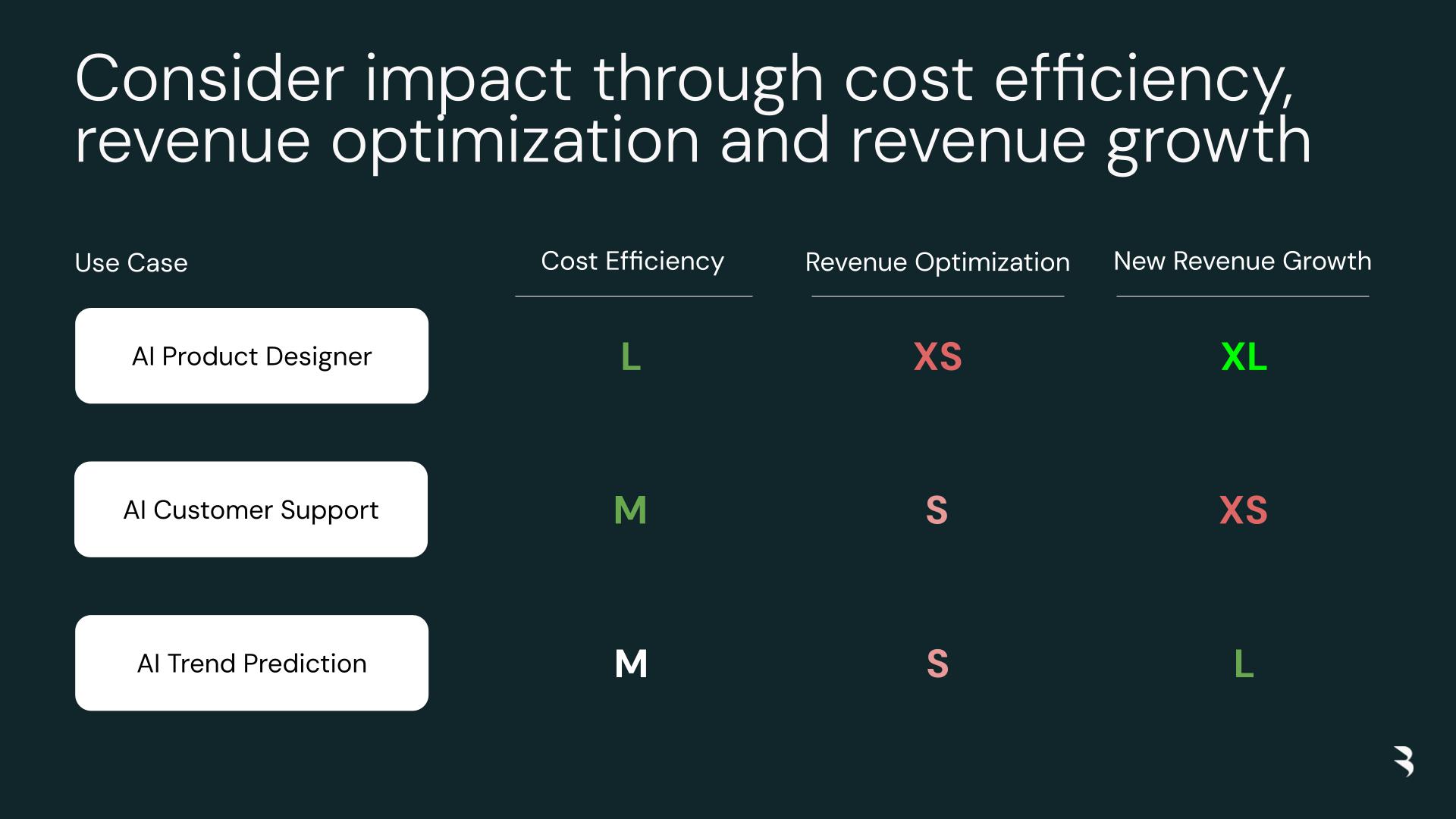
When identifying a use case, leaders and teams are sometimes paralysed from the choice between too many nascent ideas. When overwhelmed with bottom-up suggestions, a simple ROI “T-shirt sizing” exercise helps.
Start by evaluating potential value across three ROI buckets:
- Cost efficiency: How can we do what we do today faster or for less, like automating customer support tickets.
- Revenue optimization: How can we maximize revenue using existing products and customers, such as by using personalized pricing models.
- Revenue growth: What new markets, products, or customer segments could AI unlock?

Top-down buy-in
Even the best use cases will stall and fail without organizational support.
Early-stage alignment from leadership ensures resources flow toward high-impact projects. One note of caution: A “T-shirt” sizing exercise might win your stakeholders’ approval, but top-down buy-in is critical for sustained momentum. Without it, teams risk running out of steam or misalignment mid-project.
Always tie technical goals to clear KPIs that resonate with decision-makers.
Consider impact through cost efficiency, revenue optimization and revenue growth
If you have a lot of potential use cases to build for, one fast way to get unblocked can be quantifying their cost, revenue impact, and the potential for new revenue growth through a familiar “T-Shirt sizing” framework:
2. Deciding to build or go off-the-shelf
Choose custom-built tools for unique advantage
Once your use case is defined, the next step is deciding whether to build a custom solution or buy something off the shelf. The right choice depends on what you’re solving for and how unique your context is.
Choose custom build when:
- You want to create proprietary IP and long-term competitive advantage
- You require highly specific capabilities not available in general tools
- Your use case is deeply tailored to your business logic, data, or workflows
- You want to activate proprietary data sets that off-the-shelf solutions can’t access
For instance, long-term forecasting models often require nuanced understanding of a specific product portfolio, something generic tools can’t deliver without significant trade-offs.
Where custom AI doesn’t pay off
Custom builds aren’t always worth it. Watch out for these red flags:
- Low usage: If it’ll only be used a few times per year, it may not be worth the investment of a whole custom built.
- Small user base: Building for only a few users rarely makes economic sense.
- Unclear ROI: If there’s no clear business case, no cost savings, growth, or strategic value.
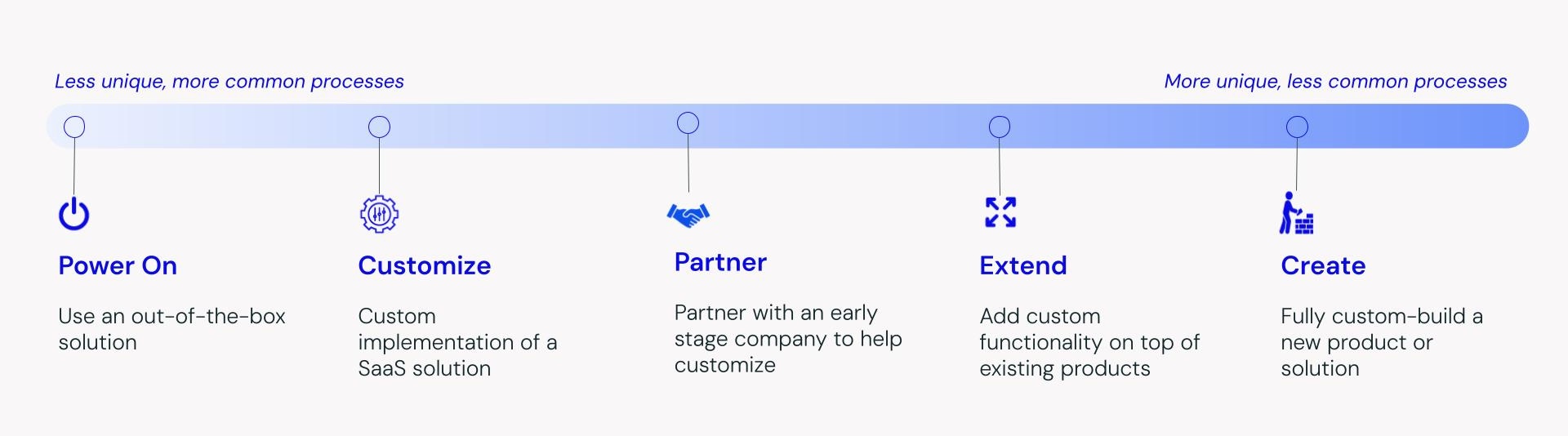
Buy vs. Build is a spectrum. Not binary.
There’s a whole spectrum between a plug-and-play and fully bespoke solution.
You might use a pre-trained model but customize the interface. Or tweak the semantic layer or data-processing timeline while keeping the core intact.
There’s no black and white answer to the question of buy vs. build, and it’s often a mix:
3. Aligning stakeholders and your team
Keep business and tech teams in sync
In AI builds, aligning your business and technical teams is foundational, since GenAI tools often produce “squishy” outputs that are difficult to benchmark in binary terms. What makes an insight “deep”? What defines a good recommendation? These are not easy questions and require alignment between the team creating the logic and the domain experts using it.
That makes it essential to define success criteria early and expose edge cases to your engineers as soon as possible. When tech teams clearly understand the business need, they can tune models and logic much faster.
Expose the logic, not just the output
One effective way to deal with distrust of AI outputs or misalignment on expectation is making the logic visible to the user. Rather than treating AI like a black box, exposing how inputs were interpreted or why a suggestion was made builds trust and improves feedback loops.
4. Considering data strategy
Don’t overrate your internal data
One of the most common pitfalls in AI projects is placing too much emphasis on internal data. Companies are often too fixated on the data they have, and this mindset can become a handicap.
Internal data might feel like the obvious starting point, but teams frequently get locked into the idea that we must use it, even when it’s not the best option for the build. In practice, this leads to stalled progress or unnecessarily complex solutions.
Start from the outcome, not the data
Rather than beginning with what you already have, start by defining the outcome you want to achieve. Ask: What’s the real outcome we’re building toward? Then source the data most likely to help you get there, even if it’s external or unstructured.
Often, that means looking beyond your own systems:
- External data: Public sources or third-party datasets often provide higher-quality inputs for building early-stage AI capabilities, especially when internal systems are fragmented.
- Goldmines of unstructured data: Reports, presentations, and PDFs (like Nielsen studies or past consumer insight decks) are frequently underused, even though they contain valuable knowledge.
- Data combinations: Some of the best builds combine limited internal data with complementary external sources.
Avoid data perfectionism early on
It’s tempting to hold off on building until all your data pipelines are clean and complete. But that delays value. Instead, validate early (even if your data is rough) and prove value with a POC before you invest in backend or frontend development.
Ultimately, you don’t need 15 datasets to make an MVP work. You need 2–4 good ones, a clear outcome, and a flexible mindset. The rest can follow after you prove the impact of your solution.
5. Designing your solution
After understanding impact, go deep on context
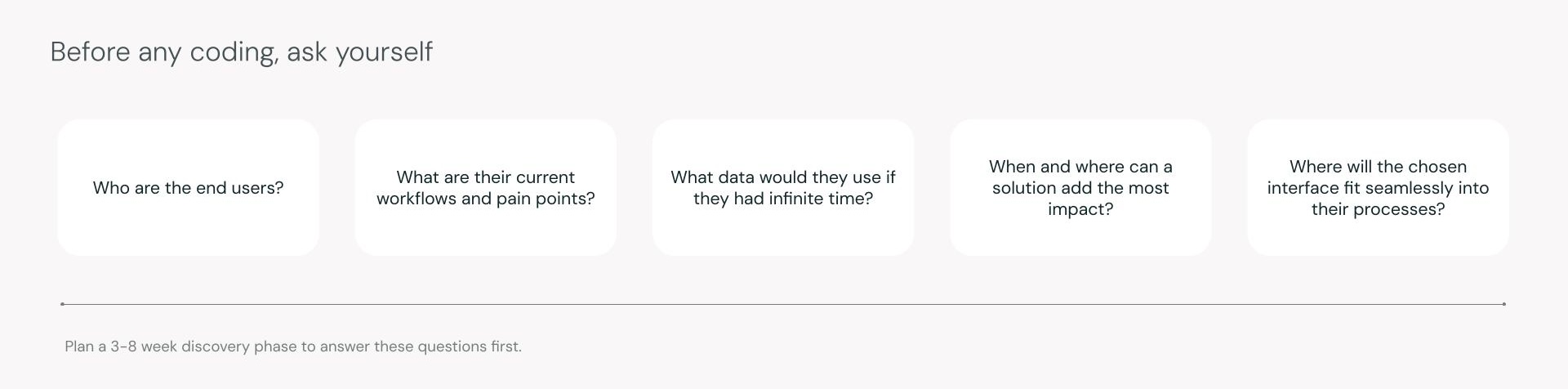
One of the most overlooked steps in AI projects is gaining understanding of the real user context. Teams often don’t spend enough time exploring how people think, work, and make decisions. That’s where many pilots fail.
Start by sitting down with domain experts and understanding how they operate. What data do they use or wish they had access to? What are the friction points in their current workflows? What does “good” output look like in their world?
Your goal in this phase should be absorbing both institutional knowledge and the surrounding business logic: what users do, what they could be doing, and who they serve.
Designing for trust
Many AI pilots have failed because teams didn’t consider how the solution would be used in practice. Adoption hinges on trust and integration. For example:
- If your AI is generating insights, what makes those “insightful”? The logic behind the output matters.
- If the model is surfacing recommendations, how can users see the reasoning behind them?
One effective approach is exposing the logic behind your tool. Let users trace how an output was generated. This increases transparency, boosts trust, and improves feedback loops.
User interfaces matter
Most AI tools do a lot in the background to be adopted. AI doesn’t always need a new interface, or an interface at all. Well-designed solutions that fit user context to allow them to better collaborate with AI will be adopted more quickly.
Other times, new interaction modes (like multimodal AI or collaborative agents) unlock more value, especially when tools are meant to serve teams, not just individuals.
The key is designing your interaction model intentionally, with the end-user experience in mind from day one.

6. Prototyping, building, and scaling
Start small
AI projects that succeed share a pattern: they start small, prove value quickly, and scale with purpose. But many never make it past the pilot. Most AI use cases don’t fail due to poor ideas. They fail because teams either try to scale too soon or build in a way that makes scaling impossible later, such as overreliance on manual code.
Instead of chasing data perfection upfront, focus on proving the concept as quickly as possible. Use workarounds, external data, or partial inputs if needed. The goal is to show business value early, not to build the perfect backend from day one.
But build with scale in mind
The step from POC to MVP is often where things fall apart. Many MVPs are designed for demos, but become impossible to scale. If the MVP relies on manual code or disconnected data pipelines, the handoff to the team who will use the tool can become a dead end.
That’s why it’s crucial to design your MVP architecture to be modular and flexible. Even if the early version is simple, it should be scalable by design, so that teams can build on top of it without starting over.
Avoid common adoption traps
Scaling a new solution isn’t just technical, it’s also cultural. Many AI solutions target users who have never worked with AI before. That creates friction if:
- The tool doesn’t fit into existing workflows
- Teams don’t understand how it was built or how to use it
- There’s no clear business case to support adoption
How do you overcome that? Transformation is complex and there’s no one-size-fits-all approach, but here are six tips to get you on the right track.
- Fit the tool into the existing workflows of your users
- Craft a strong story, especially if users are new to AI or unfamiliar with the tech. Why should anyone use this tool? What are the benefits?
- Build internal fluency. Explain what a POC is, how it becomes an MVP, and what’s needed to scale.
- Have your business case ready, show how the tool impacts cost, revenue, or time savings.
- Onboard users early, even during the POC phase, to test and shape the solution.
- Involve both business and digital leaders, since most tools live at the intersection of strategy and technology
AI solutions built for commercial impact
Designing, building and running custom AI solutions that deliver real results. We focus on what existing challenges AI can solve and what entirely new opportunities AI can create.
Putting it all together
The best AI solutions thrive at the intersection of technical capability, business strategy, and human-centered design.
Start by identifying high-impact use cases with clear ROI, then build tools that empower teams across departments to interact with AI in ways they find intuitive. Along the way, overcommunicate (about what your solution does, how it works, and why it matters) to bridge knowledge gaps and align expectations.
By designing for broad impact rather than isolated wins (like taking into account how each outcome can help adjacent teams move faster and more effectively), you’ll build AI tools that are truly transformative.