For services firms, the biggest competitive threat is their own clients

Amir Ouki
Managing Director Applied AI & Technology, Americas
Professional services firms face a structural shift in how AI reshapes their business models. The biggest competitive threat is not a cheaper rival. It is the client’s own team, armed with general-purpose AI tools, producing rough versions of deliverables that reframe the entire value conversation.
AI is forcing services firms to rethink their business model
For decades, professional services firms charged clients a rate that was never fully itemized, and clients paid it without asking too many questions. Not because they weren’t curious, but because they had no frame of reference. The work was complex, the outputs took time, and what exactly went into producing them was difficult to verify from the outside. That difficulty had real value. Clients paid a trust premium on top of the actual expertise because they had no way of knowing what it would cost to do it differently.
AI is removing that protection. And the main agent of that removal is not always a cheaper competitor undercutting on price. It is the clients themselves.
The moment the relationship changes
When a client’s internal team uses a general-purpose AI tool to produce a rough version of a deliverable in an afternoon, two things happen simultaneously. The output itself is probably not good enough to replace the firm. But the person who produced it walks into their next meeting with a completely different sense of what the work involves. They have seen how far you can get in a few hours, with no specialized training and no proprietary methodology. They now have a reference point they did not have before and that reference point does not go away.
Consider a market research firm engaged to produce a competitive landscape report for a consumer goods company. The final report takes four weeks and runs to sixty pages of structured analysis, validated data sources, and interpreted findings. It is, by most measures, good work. But if a junior insights manager on the client side has spent an afternoon with an AI tool and produced a thirty-page draft covering most of the same ground, the conversation at the next briefing is different. The question being asked (even if it’s not out loud) is: what did those four weeks actually add?
That moment does not require a formal vendor review to trigger it. It does not require a board-level decision about insourcing. A junior employee produces something rough and shows it to their manager. The manager looks at it. That conversation, between two people who may never sit in a procurement meeting, is the moment the relationship changes. The scrutiny that follows is much more persistent than any competitive pitch.
The same dynamic plays out across sectors. An investment bank’s client uses AI to draft its own preliminary valuation model before the kick-off call. A pharma company’s regulatory affairs team generates a first-pass gap analysis before the compliance firm has been briefed. A retailer’s marketing team builds a rough customer segmentation before the research agency has submitted its proposal. In each case, the output is imperfect. In each case, the client now knows something they did not know before.
What do you do when AI makes your service, product or pricing obsolete?
May 21
+5,000 attendees
Virtual summit
When the invoice gets pulled apart: the unbundling of service business models
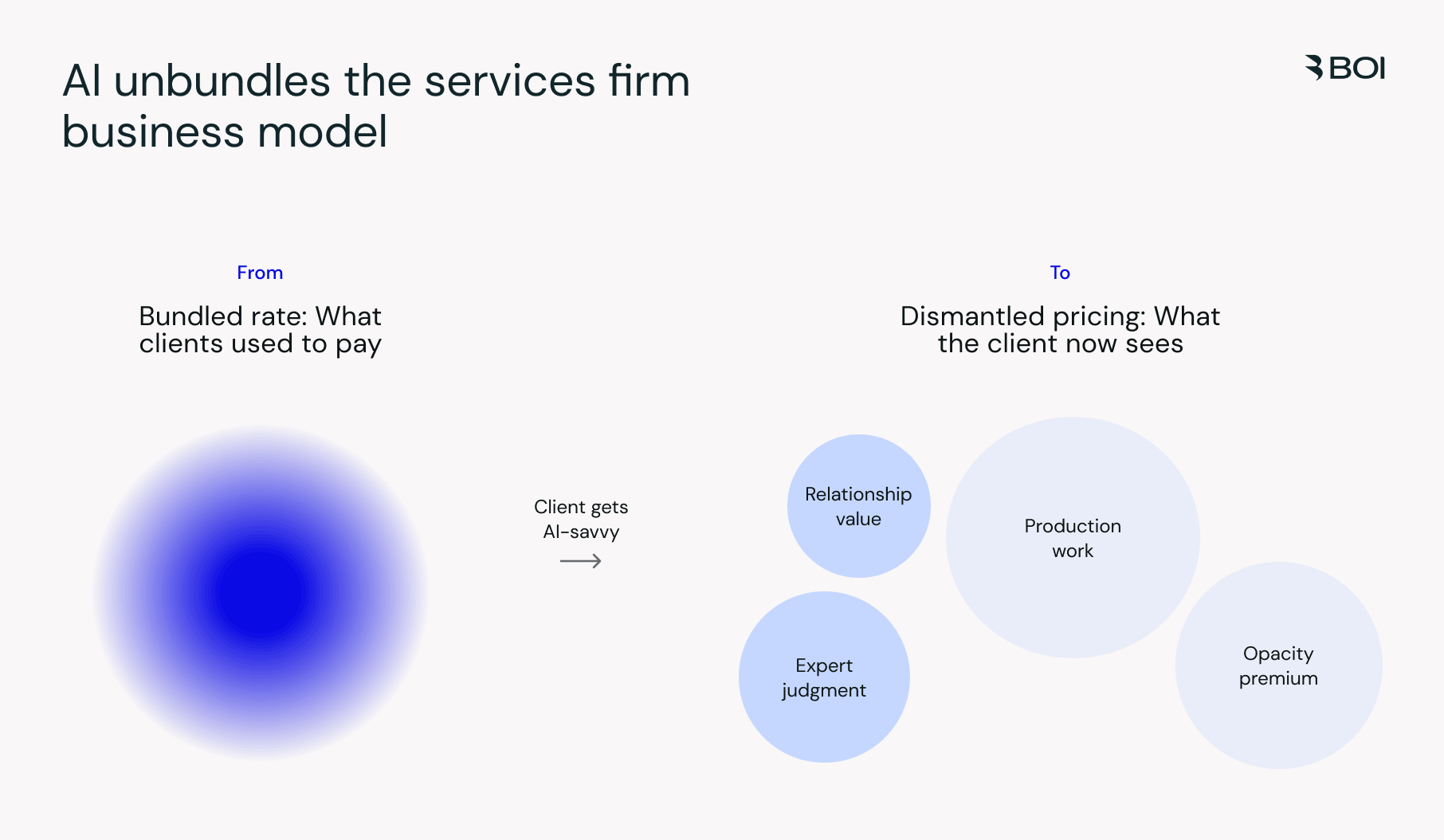
The pricing model that most services firms use has always bundled four things together into a single rate: the work of producing analysis and structured outputs, the exercise of genuine expert judgement, the value of the ongoing relationship, and the implicit fee for the client not being able to verify any of the above. That bundle worked because the components were invisible. Clients had no basis for pricing them separately, and firms had no reason to try.
AI is forcing that separation. As AI tools absorb the work of producing analysis (think: research, outputs, structured data interpretation, etc.) the remaining components become visible as distinct items for the first time. Firms that have never had to price those components individually are discovering that the bundle held together partly because the components were hard to see, not because each one was worth what the blended rate implied.
Take a law firm. The hourly rate has always covered research, drafting, and the judgement to know which arguments will hold. AI may now handle the research and a significant portion of the drafting. What remains is the judgement: the senior lawyer’s read on a counterparty, the instinct developed through years of similar transactions, the ability to know when a clause that looks standard is actually a liability in this specific context. That judgement is real and it is valuable. But it now needs to stand on its own, priced and justified separately from the work that used to surround it.
The uncomfortable finding
For many services companies across sectors, this next part is no fun. The judgement they assumed clients were paying a premium for turns out, in many cases, to have been deeply entangled with the intelligence work that surrounded it. The partner who led a transaction did so partly on instinct and experience, but also because they had spent hours in the data. The senior consultant who made the strategic call did so partly on judgement and experience, but also because they had run the workshops, reviewed the outputs, and absorbed the organization’s context through weeks of embedded work. Without that surrounding work, the judgement is thinner than it appears from the outside, and thinner than the firm has been telling itself.
The firms that come through this well are the ones whose judgement is genuinely rare and genuinely separable: the specialist whose call changes the outcome in a way that no amount of AI-assisted analysis could replicate, the relationship that carries trust built over years, the creative instinct that produces something the client recognizes as different from anything they could have produced themselves. Those firms have an opportunity: the unbundling actually works in their favor, because they can now price the thing that is genuinely scarce without burying it inside a blended rate that also covers work AI can now do cheaply.
But those firms are fewer than the industry would like to believe. A larger share of what the industry has been calling judgement was always closer to intelligence: complex and valuable, but replicable. The distinction was invisible when intelligence was expensive to produce. It becomes visible the moment it is not.
This requires asking the hard question
Navigating this means being willing to ask a direct question: what, specifically, are we charging for, and would a client with an AI-capable internal team find that answer credible? Not in the language of methodologies or proprietary processes, but at the level of what the client actually receives and what it would genuinely cost them to get it another way.
That question is harder to answer than it sounds and most services companies have never had to answer it before. For years, the answer was implicit in the rate and accepted without scrutiny. The fact that it is now being interrogated by clients themselves, with their own tools, is what makes this a structural shift rather than a temporary pricing problem. The scrutiny will not ease as AI tools improve. It will increase.
If you’re starting to feel the pressure, we should talk.
At BOI, this is the work we do with services businesses navigating this transition. Not rebranding an existing model, but identifying which parts of the value proposition hold under scrutiny, which parts were always dependent on opacity, and what a compelling and defensible offer looks like once those are separated.

Managing Director Applied AI & Technology, Americas
Amir leads BOI’s global team of product strategists, designers, and engineers in designing and building AI technology that transforms roles, functions, and businesses. Amir loves to solve complex real world challenges that have an immediate impact, and is especially focused on KPI-led software that drives growth and innovation across the top and bottom line. He can often be found (objectively) evaluating and assessing new technologies that could benefit our clients and has launched products with Anthropic, Apple, Netflix, Palantir, Google, Twitch, Bank of America, and others.
[email protected]