How our AI innovation engines actually work
A look under the hood

Amir Ouki
Managing Director, Applied AI & Technology
Over the last few years, we have worked with global enterprises to design, test, and scale AI-native innovation capabilities. These systems are now running inside some of the world’s largest organizations. They help teams move faster, act with more clarity, and create a learning ecosystem that strengthens with every project.
We often get asked: What actually sits underneath these capabilities? How does the engine operate? What links the signals, the insights, the concepts, and the decisions? And how do these systems build confidence instead of risk?
We’ve decided to open up the hood, so you can see how our AI innovation engines work in practice.
But first: what is an AI innovation engine?
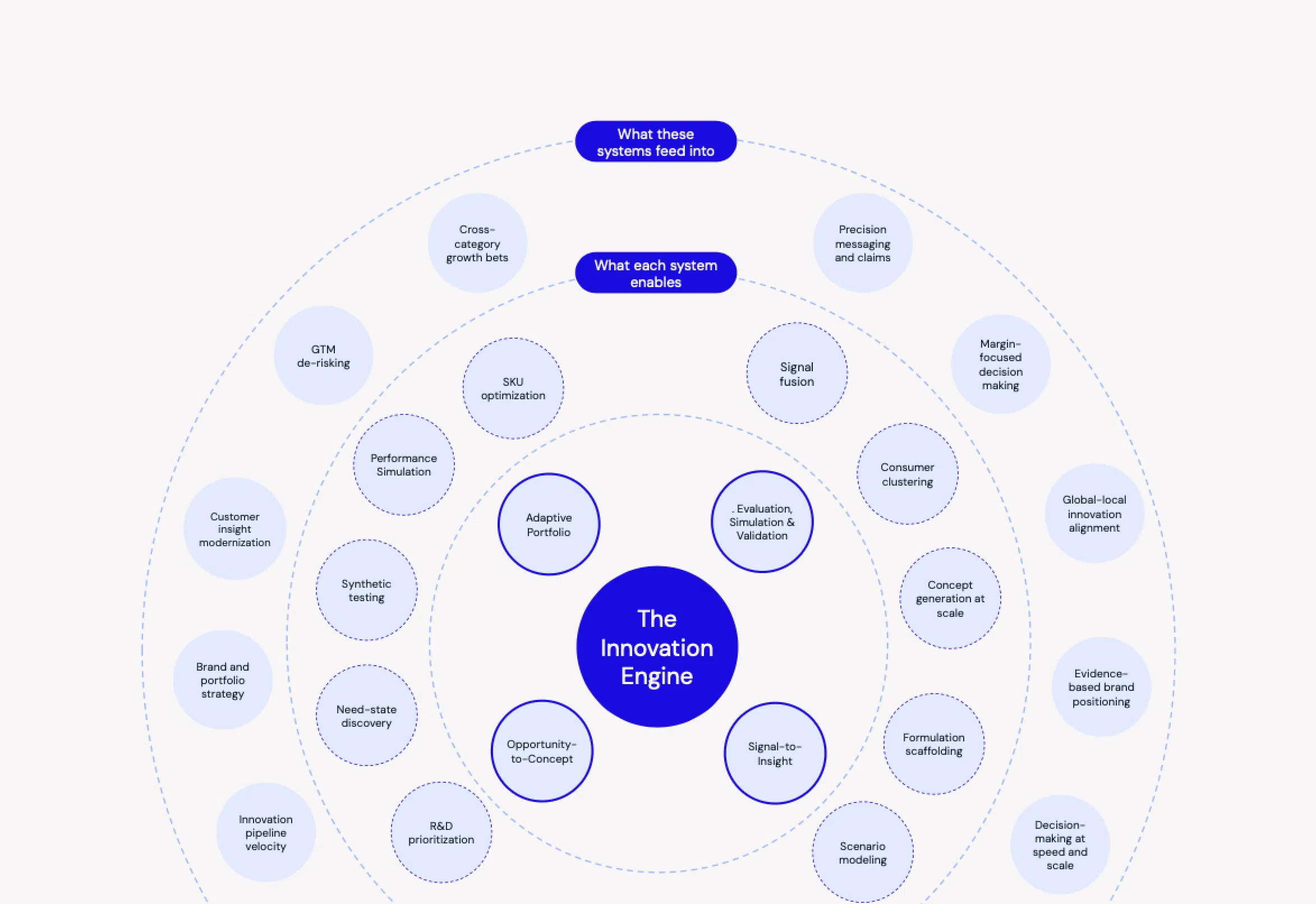
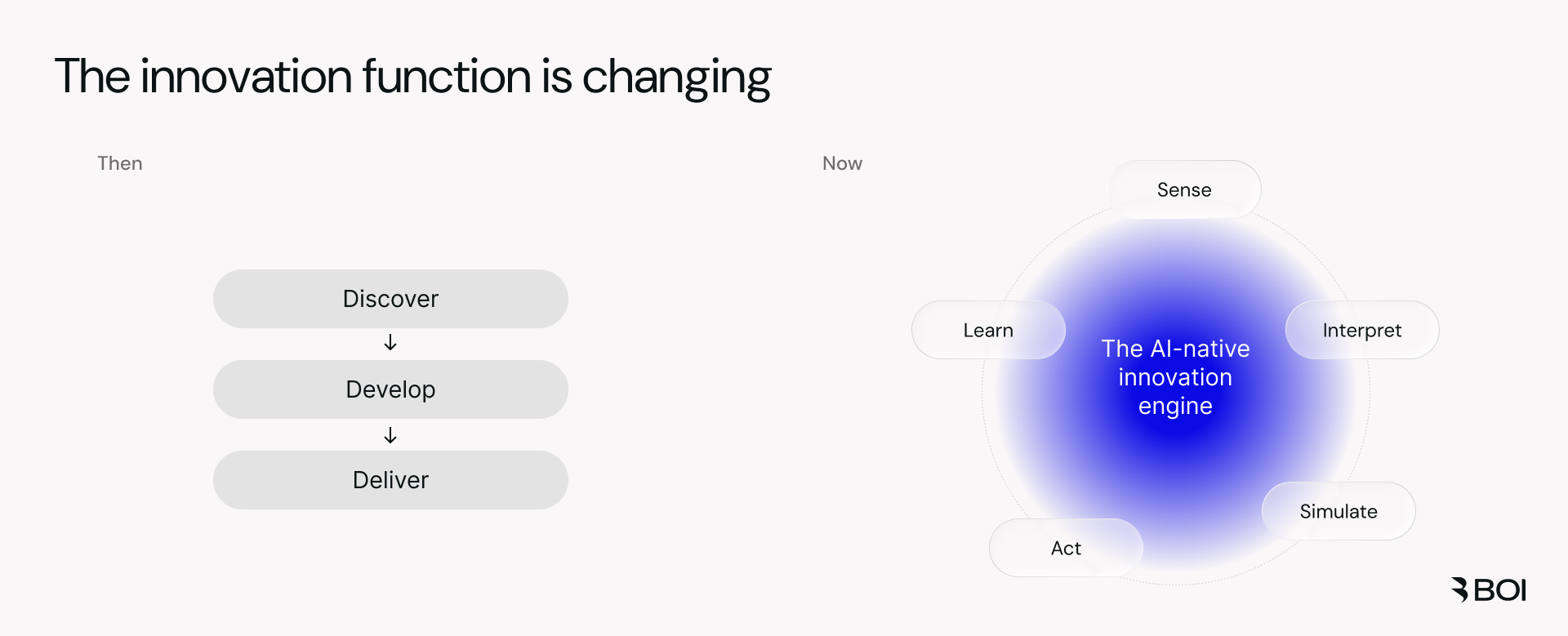
An AI innovation engine is a living system. It senses, interprets, simulates, acts and learns. New signals trigger validation. Simulation models guide decisions. Every output creates new data that strengthens the next cycle. Instead of sequential handoffs, innovation becomes a dynamic network of feedback loops – and intelligence itself becomes the organizing principle of innovation.
Dive deeper into how AI is rewiring the innovation function.
What intelligence means for innovation
Intelligence is the ability to make better decisions by analyzing complex data at scale, applying commercial logic to it, and acting with evidence-backed confidence.
For innovation teams, this means:
- Connecting insights across consumers, markets, and culture.
- Turning data into actionable insight and foresight.
- Building competitive feedback loops that learn and improve with every iteration.
AI enables these capabilities – at scale – giving enterprises faster awareness, sharper analysis, and more confident decisions.
1. A connected intelligence layer as the base
Every engine begins with a connected intelligence layer. This combines internal data, external signals, and third-party sources into a single foundation. Most companies already have these datasets but they often sit in silos. AI brings them together and interprets them with near-human context at a scale that teams cannot match manually.
This foundation is not a dashboard. It is a semantic layer that understands relationships across consumer behavior, market performance, scientific research, competitive activity, and cultural signals. It evolves as new inputs flow in and becomes the shared intelligence layer for every part of the engine.
One principle we’ve learned: if you want an engine you can trust and scale, you typically have to build it in your own environment. Not by training massive models from scratch, but by standing up these capabilities inside your security protocols, so your data and IP stay yours (and compounds with time).
2. Always-on sensing of market shifts
Once the foundation is in place, the engine begins to sense change continuously. It monitors shifts in consumer sentiment, category conversations, competitive claims, supply chain movements, regulatory changes, and demand signals. It can also pull from internal activity such as project performance, previous research, and historical experiments.
This sensing identifies early indicators that often appear long before teams would normally see them. The engine can highlight emerging tensions, new adjacencies, shifts in preferences, or early formation of new categories. These signals become the raw material for opportunity spaces.
3. Turning signals into insights
AI then interprets these signals and turns them into structured insights. This is where the intelligence layer becomes powerful. It identifies recurring patterns, contrasts markets, detects hidden relationships, and connects data points that would be invisible in traditional research.
The outcome is a differentiated insight base that is fully owned by the company. Each insight becomes a reusable asset that strengthens over time. The more the system learns, the more accurate and predictive it becomes.
4. Evidence-based opportunity spaces
From these insights, the engine generates opportunity spaces. These are grounded in clear evidence rather than intuition or static trend reports. Each opportunity is linked to the signals that created it, and the system can show why it matters, how fast it is growing, and which conditions support it.
Teams can explore multiple spaces at once and interrogate the underlying drivers. They can adjust variables, ask new questions, or go deeper into the data. The engine becomes a partner in discovery rather than a tool that pushes out recommendations.
5. Concept creation grounded in intelligence
Once opportunities are defined, concept creation begins. Unlike earlier phases of generative AI, which focused only on volume, the concepts produced inside the innovation engine are guided by context. Each idea is tied back to the insight, the problem framing, the signals, and the intended audience.
Teams can generate names, claims, visual expressions, product features, service ideas, or business model directions. Everything is grounded in the intelligence layer, which increases the relevance and coherence of the ideas.
A practical playbook and 90-day roadmap to build an AI-first business that operates, learns, and grows with AI at its core.
6. Rapid simulation and validation
Innovation teams are simulating real-world conditions before investing in prototypes or market tests. Instead of relying on slow, expensive consumer studies or small pilots, teams can now run hundreds of virtual experiments. All powered by live and historical data.
These validations help teams prioritize confidently.
Dynamic consumer testing
- AI models are trained on historical sales, behavioral, and psychographic data to generate synthetic audiences that mirror real consumer segments.
- These “digital twins” respond to new concept descriptions, designs, or pricing strategies, allowing teams to test reactions at scale – instantly.
- Feedback is structured and quantified, revealing which features or messages drive the strongest predicted uptake.
Market simulation environments
- Multi-agent simulations replicate real competitive and economic dynamics – modeling how a new concept would perform under different pricing, distribution, or competitor entry conditions.
- Teams can run “what-if” experiments (e.g., What happens if a low-cost competitor launches 6 months later?) and compare potential scenarios.
Technical feasibility, viability, and sustainability
- AI models analyze production constraints, materials data, and environmental impact to predict feasibility early in the process.
- Digital twins of manufacturing systems simulate production capacity and carbon footprint, flagging risk areas before R&D investment.
7. Continuous, living portfolio
All opportunities and concepts feed into a living portfolio. Instead of quarterly reviews and static stage gates, the portfolio updates continuously. Opportunities are rescored when new data comes in. Concepts move up or down in priority based on validation outcomes, market shifts, or strategic considerations.
This creates a more adaptive and realistic view of where the organization should invest. It also helps leadership make decisions with far less uncertainty.
The full engine operates as a continuous loop
Signals flow in
The system senses changes across internal and external environments.
Insights emerge
AI interprets the data and identifies patterns.
Opportunities form
Clear, evidence-backed opportunity spaces are created.
Concepts are generated
Ideas are developed with context and precision.
Simulations test outcomes
Validation cycles move early in the process.
The portfolio updates
Decisions become continuous rather than episodic.
Learning compounds
Every cycle strengthens the intelligence layer.
The organization ends up with an innovation model that moves in real time and becomes more effective with every iteration.
Humans-in-the-loop
The engine does not replace human innovators. It changes their role. Humans interrogate insights, frame problems, challenge assumptions, refine opportunities, and guide strategic decisions. They also set ethical direction, define the logic that the engine uses, and orchestrate how intelligence moves across functions.
The strongest results come from human innovators working with a system that is designed to learn with them.
An AI-native innovation function is an operating system for growth
It is not a toolset or a dashboard. It is an operating system for growth powered by intelligence, clarity, and continuous learning. Teams can move faster without cutting corners, make better decisions with more confidence, and build a defensible intelligence foundation that is unique to the organization.
Discover how you can build a defensible AI-native innovation capability.
Keen to explore what an AI-native innovation engine could look like for you? Drop us a note.

Managing Director, Applied AI
Amir leads BOI’s global team of product strategists, designers, and engineers in designing and building AI technology that transforms roles, functions, and businesses. Amir loves to solve complex real world challenges that have an immediate impact, and is especially focused on KPI-led software that drives growth and innovation across the top and bottom line. He can often be found (objectively) evaluating and assessing new technologies that could benefit our clients and has launched products with Anthropic, Apple, Netflix, Palantir, Google, Twitch, Bank of America, and others.
[email protected]