How our AI innovation engines actually work
A look under the hood

Amir Ouki
Managing Director, Applied AI & Technology
Innovation teams have relied on the same linear funnel for decades. Insights moved into concepts, concepts moved into development, and a small percentage eventually reached the market. This approach worked when markets were stable and predictable.
They no longer are.
Faster moving markets requires a more dynamic approach to innovation
Today the environment looks very different. Markets shift quickly, competitor activity moves in real time, and data flows into organizations faster than traditional processes can absorb.
Many companies are now replacing the funnel with something more dynamic. The emerging model looks less like a pipeline and much more like an operating system. It senses change, interprets signals, adapts based on new information, and guides teams toward stronger decisions. This is the foundation of the AI-native innovation engine.
AI capability building is a strategic imperative
Innovation teams are feeling pressure from two directions, making AI capability building less of an experiment and more of a strategic requirement.
Inside organizations, teams are expected to deliver more with fewer steps
- Legacy stage gate systems slow everything down.
- Validation cycles take months.
- Vendor stacks grow heavier every year, adding more friction than value.
The result is concept fatigue. Everything starts to feel like a recycled version of something that already exists.
Outside organizations, the context has shifted
- Insight parity is the norm.
- Most companies buy from the same research vendors and use the same syndicated data.
- At the same time, early adopters of AI capabilities are moving faster. They identify shifts while others are still defining research scopes. The gap between early movers and everyone else is widening.
- Vendor fatigue and tool overload.
- Shift in innovation roles from process to product
From generating ideas to generating intelligence
Wave 1 of AI adoption focused heavily on idea generation. It was exciting and helped teams understand what AI could do. Over time it became clear that producing more ideas was not enough.
The real shift happened when AI moved upstream. Once concept generation connected to opportunity discovery and the underlying data, the system became much smarter. AI began generating data-backed opportunities, not just ideas. This is the turning point that sets the stage for a true innovation engine.
The emphasis has moved from generating ideas to generating intelligence.
A practical playbook and 90-day roadmap to build an AI-first business that operates, learns, and grows with AI at its core.
What an innovation engine is
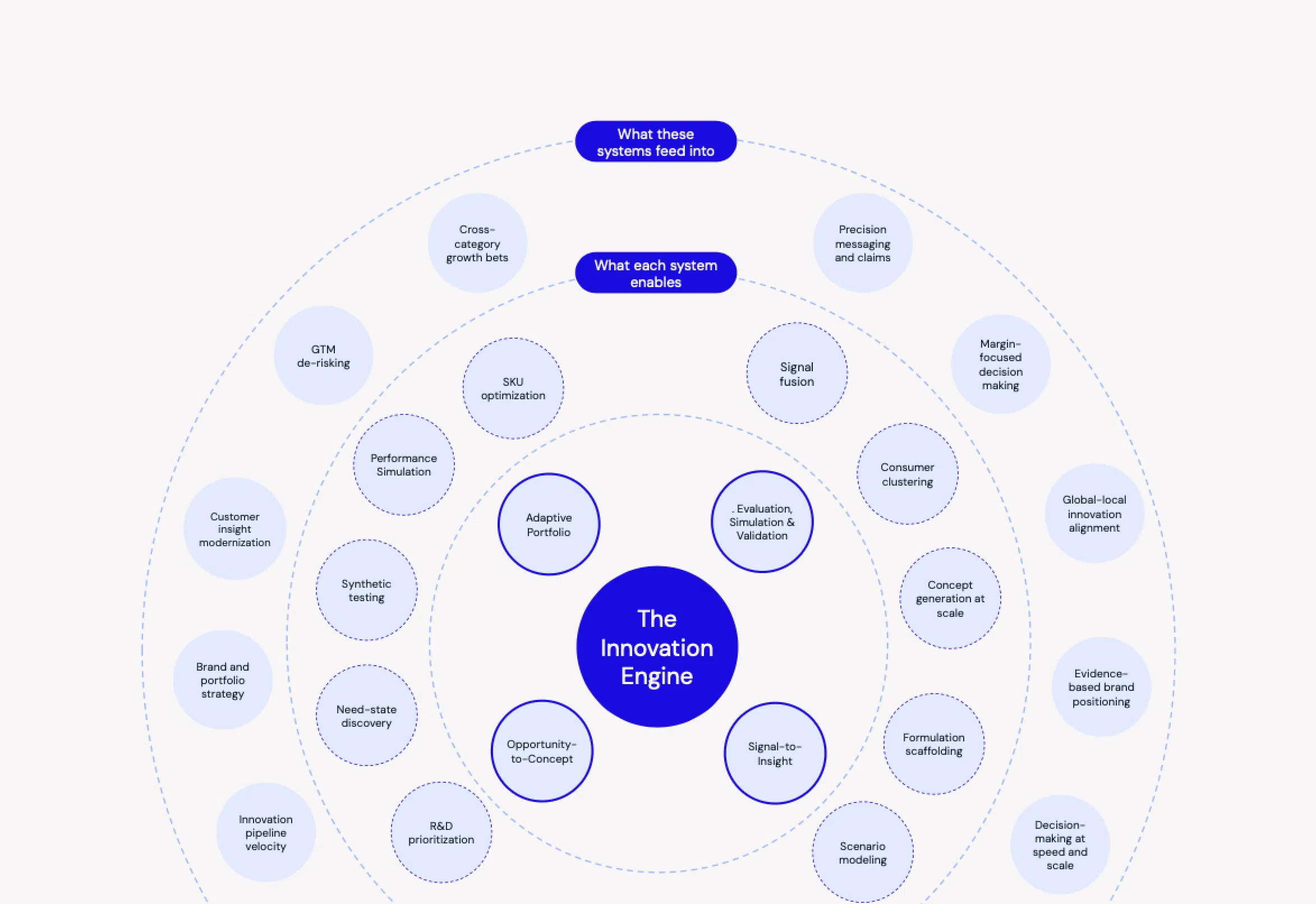
An innovation engine is a living system. It senses, interprets, simulates, acts and learns. New signals trigger validation. Simulation models guide decisions. Every output creates new data that strengthens the next cycle. Instead of sequential handoffs, innovation becomes a dynamic network of feedback loops – and intelligence itself becomes the organizing principle of innovation.
What intelligence means for innovation
Intelligence is the ability to make better decisions by analyzing complex data at scale, applying commercial logic to it, and acting with evidence-backed confidence.
For innovation teams, this means:
- Connecting insights across consumers, markets, and culture.
- Turning data into actionable insight and foresight.
- Building competitive feedback loops that learn and improve with every iteration.
AI enables these capabilities – at scale – giving enterprises faster awareness, sharper analysis, and more confident decisions.
The four pillars of AI-native innovation
AI is reshaping innovation across four connected dimensions of intelligence.
These four components create an innovation engine that learns from everything the organization does. Every insight, every experiment, and every launch becomes part of a growing intelligence foundation.
1. Insight differentiation
Revealing patterns and opportunities invisible to human analysis.
Insights become proprietary assets that competitors cannot easily replicate.
Instead of buying static trend decks, organizations integrate internal, external, and third-party data into one intelligence layer. AI can detect hidden relationships, emerging needs, and early shifts that humans cannot spot at scale.
2. Portfolio intelligence
Managing innovation as a living, data-driven ecosystem instead of a linear funnel.
Decisions become continuous rather than tied to quarterly reviews.
Portfolios are managed as living ecosystems. Opportunities rise and fall based on new information. The system keeps track of competitor moves, market signals, supply shifts, and consumer data.
3. Simulation and validation
Testing desirability, viability, feasibility, and sustainability before market launch.
Data-backed decisions improves confidence and reduces wasted investment.
Teams can evaluate desirability, feasibility, and viability before prototypes exist. Synthetic audiences, multi-scenario models, and technical simulations create evidence long before real-world testing begins. This improves confidence and reduces wasted investment.
4. Dynamic opportunity sizing and foresight
Using live data and predictive models to guide long-term investment and growth bets.
AI connects internal performance metrics with external signals and recalculates market boundaries as conditions evolve. Teams can detect early formation of new categories, size adjacent spaces, and adjust forecasting in real time.
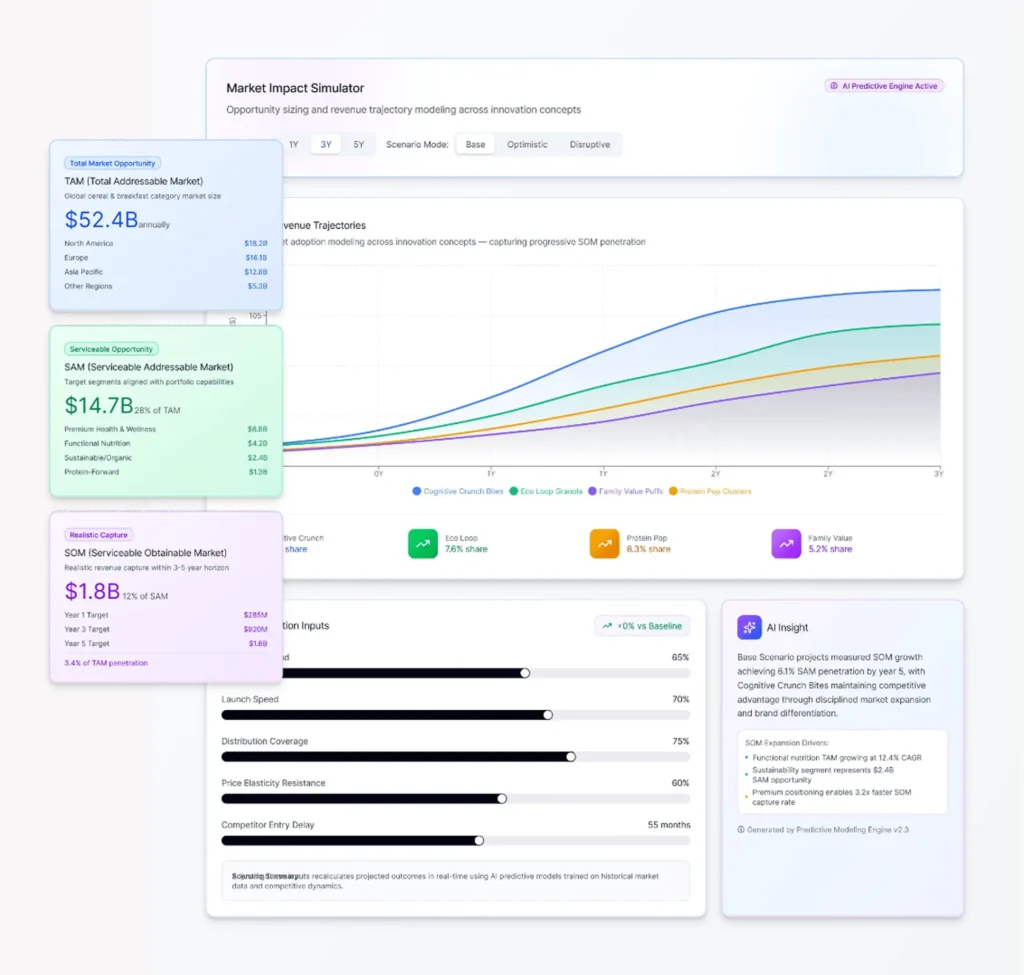
The AI-native innovation engine increases the rate of successful launches, defensibility, and speed
An AI-native engine increases the rate of successful launches because teams work with clearer evidence. It increases defensibility because models, datasets, and knowledge graphs become proprietary IP. It increases speed because weak ideas are filtered out early and strong ideas move forward without long periods of uncertainty.
The organization becomes one that is learning faster than it acts.
Where to start this transformation
This transformation does not start with tools. It starts with identifying where the current process relies on guesswork or outdated information. Those moments offer strong entry points for AI-led intelligence.
Small experiments help teams understand where AI adds the most value. As data sources become more connected, workflows can be redesigned so intelligence sits at the center rather than the edges. Eventually insights, R&D, marketing, and commercialization operate from a shared intelligence layer. The result is a more cohesive and adaptive growth system.
Keen to explore what an AI-native innovation engine could look like for you? Drop us a note.

Managing Director, Applied AI
Amir leads BOI’s global team of product strategists, designers, and engineers in designing and building AI technology that transforms roles, functions, and businesses. Amir loves to solve complex real world challenges that have an immediate impact, and is especially focused on KPI-led software that drives growth and innovation across the top and bottom line. He can often be found (objectively) evaluating and assessing new technologies that could benefit our clients and has launched products with Anthropic, Apple, Netflix, Palantir, Google, Twitch, Bank of America, and others.
[email protected]