How to create a defensible AI-native innovation capability

Amir Ouki
Managing Director, Applied AI
Creating a defensible AI-native innovation capability is one of the most strategic moves an organization can make today. It helps teams move faster, make clearer decisions, and build an intelligence foundation that gets smarter with every cycle. This is the shift we are seeing across global enterprises.
AI is no longer an experiment. It is becoming an operating system for growth.
Why building your own intelligence matters
Over the last couple of years, many teams experimented with AI through spot tools, generative content, or small automations that solved one narrow part of the process. These experiments were important. They helped teams understand what AI can do. But they did not create competitive distance.
A defensible AI-native innovation capability requires something much stronger. It requires an intelligence system that lives inside your environment, compounds with use, and cannot be replicated by competitors.
This is the shift we see taking place across global enterprises. Leading organizations are shifting from buying insights to generating insights, and from renting tools to building capabilities that hold their own knowledge, logic, and data.
In this blog, we outline what it takes to build a defensible AI-native innovation capability inside your organization.
The limits of off-the-shelf innovation tools
Most off-the-shelf innovation platforms promise speed and automation. They can be useful for small tasks, but they rarely deliver real strategic advantage. Two issues consistently surface: security and IP ownership.
And it’s rapidly impacting not only retail, but the entire value chain.
Security
Large enterprises are reluctant to give broad access to sensitive data: consumer research, R&D pipelines, competitive strategies, and long-term roadmaps. The risks of leakage, co-mingling, or shared environments are real. Most SaaS platforms are simply not designed to operate at the security level global organizations require.
IP ownership
When you rely heavily on external platforms, your proprietary signals often train someone else’s system. Over time, the uniqueness of your intelligence erodes. If the vendor changes terms or you switch providers, the intelligence goes with them.
This is why many teams find tool-based innovation stacks underwhelming. They create activity, but not defensible intelligence.
What “building” an AI-native innovation capability actually means
Building an AI-native innovation capability does not mean training massive models from scratch. It means standing up capabilities inside your own environment. The intelligence sits within your cloud, your data governance protocols, and your security model.
The goal is simple. Create a system where the semantic layer, commercial logic, and insight structures all belong to you. As new signals and data flow in, the intelligence compounds. Over time, this becomes a strategic asset competitors cannot replicate.
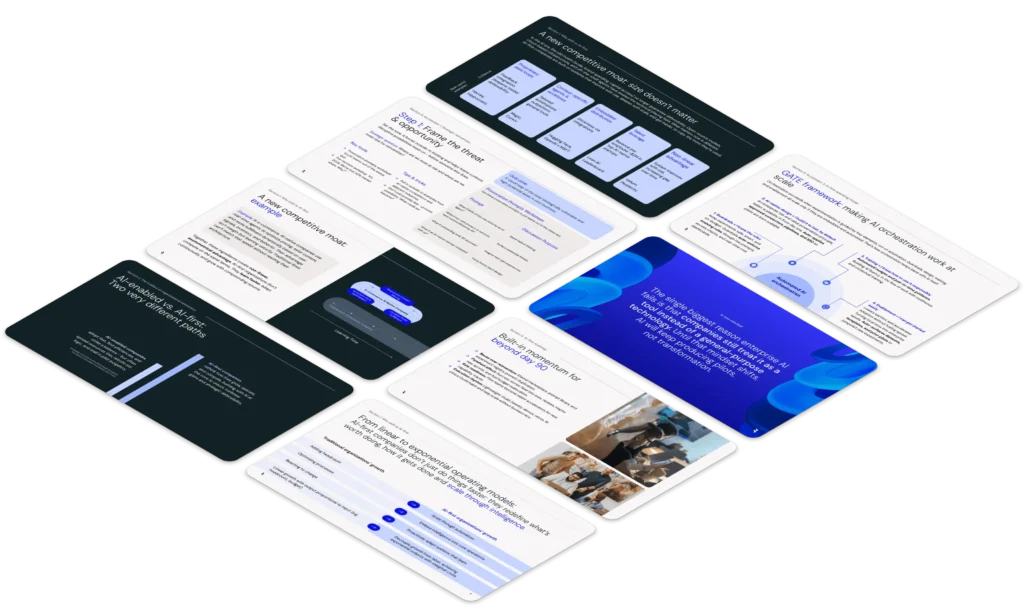
A practical playbook and 90-day roadmap to build an AI-first business that operates, learns, and grows with AI at its core.
What a defensible innovation system requires
1. A unified intelligence layer
A defensible system starts with a connected intelligence layer that brings together:
- Internal consumer research
- R&D data
- Social sentiment
- Market performance
- Cultural signals
- Third-party data
- Ethnographies and qualitative studies
- Competitive intelligence
- Scientific and patent research
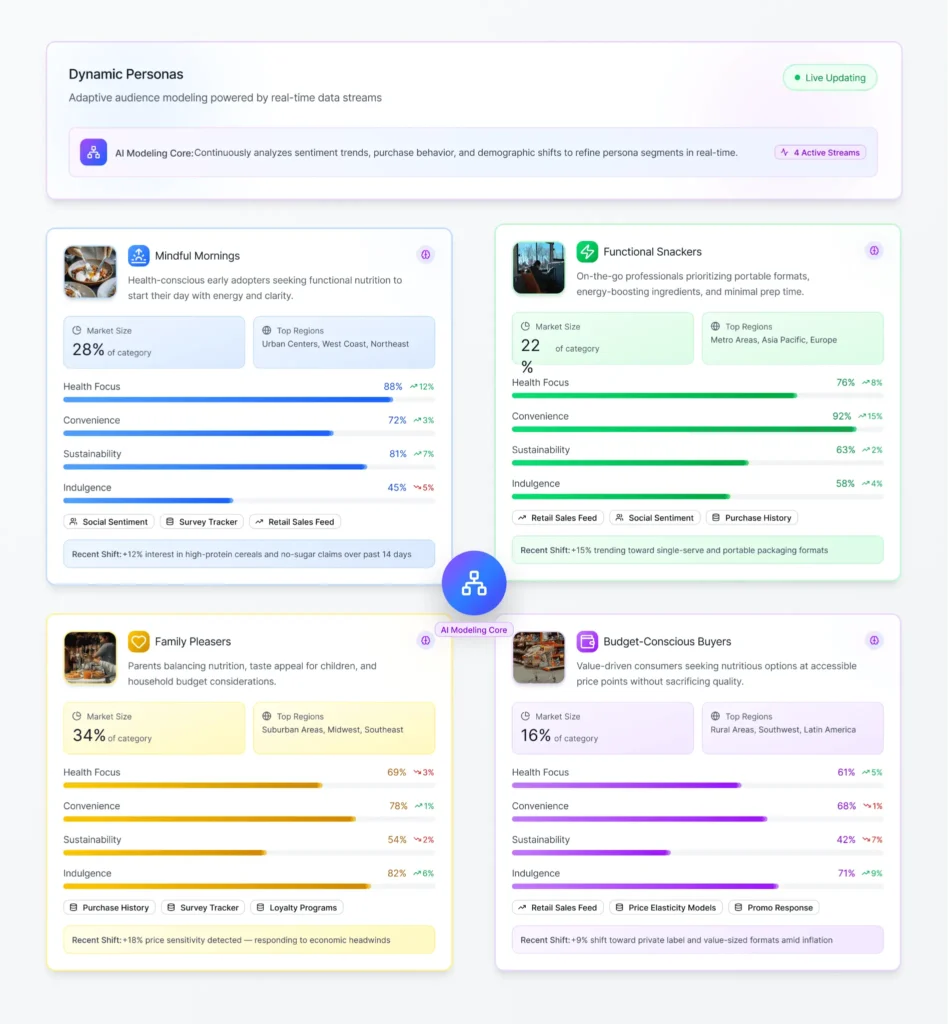
These sources often live in silos. AI brings them together and interprets them at a scale humans cannot reach manually. The result is an always-on intelligence layer that surfaces hidden adjacencies, weak signals, and emerging patterns.
Once this layer exists, every insight becomes part of a knowledge graph that compounds over time. No competitor can buy this. It is built into the fabric of your organization.
2. Generating your own insights
The shift from buying insights to generating insights is one of the biggest drivers of defensibility. AI can identify patterns, adjacencies, and market signals that traditional reports miss.
Over time, this capability becomes a structural advantage. It means you create intelligence that is unique to your organization. Competitors who rely on syndicated reports will never have access to the relationships and signals your system uncovers.
Your insights become a moat.
3. A clear logic layer
A defensible capability needs a logic layer that defines how intelligence is created and how decisions are made. This includes:
- Opportunity framing
- Scoring criteria
- Creative boundaries
- Validation parameters
- Strategic priorities
- Guardrails around ethics and brand purpose
These elements make the system feel native to your organization rather than generic. They also ensure that as models change, the intelligence stays consistent.
This layer travels across teams and becomes a shared way of understanding your markets and opportunities.
4. Simulation that creates evidence that you own
Validation is one of the most powerful contributors to defensibility. Simulation environments, synthetic audiences, and multi-scenario models let teams test desirability, feasibility, viability, and even sustainability before prototypes exist.
The outputs belong to you:
- Concept performance patterns
- Portfolio response curves
- Market resilience under different conditions
- Desirability and feasibility scores
- Regional sensitivity insights
- Risk and opportunity indicators
These simulations produce datasets that grow over time. Each validation cycle strengthens the system with proprietary evidence that only your team has. This becomes increasingly valuable as categories shift.
5. Living portfolio intelligence
When your portfolio is managed inside your own engine, every reprioritization and every decision adds intelligence back into the system. Opportunities rise and fall based on signals the organization sees first. Concepts shift based on performance, market changes, or competitive actions.
Instead of static gates, the portfolio becomes a live system that mirrors how markets actually move. The more you use the system, the stronger and more predictive it becomes. Over time, the portfolio itself becomes a competitive advantage.
6. Human-in-the-loop creates durability
Technology does not make the capability defensible on its own. Humans do. Innovators interrogate insights, refine opportunity spaces, challenge assumptions, and bring strategic judgment that AI cannot replicate.
They define the logic, ethics, and commercial direction. They orchestrate the flow of intelligence across insights, R&D, marketing, and early commercialization. When humans and AI work together, the capability becomes deeply embedded in how the organization learns and decides.
This is what makes it durable.
A defensible AI-native innovation capability is a strategic move
Building a defensible AI-native innovation capability is one of the most strategic moves an organization can make today. It allows teams to move faster, act with more confidence, and build an intelligence foundation that strengthens with every cycle.
The companies that build these systems inside their own environments will be the ones shaping markets instead of reacting to them.
Want to build a defensible AI-native innovation capability inside your organization? Drop us a note.

Managing Director, Applied AI
Amir leads BOI’s global team of product strategists, designers, and engineers in designing and building AI technology that transforms roles, functions, and businesses. Amir loves to solve complex real world challenges that have an immediate impact, and is especially focused on KPI-led software that drives growth and innovation across the top and bottom line. He can often be found (objectively) evaluating and assessing new technologies that could benefit our clients and has launched products with Anthropic, Apple, Netflix, Palantir, Google, Twitch, Bank of America, and others.
[email protected]